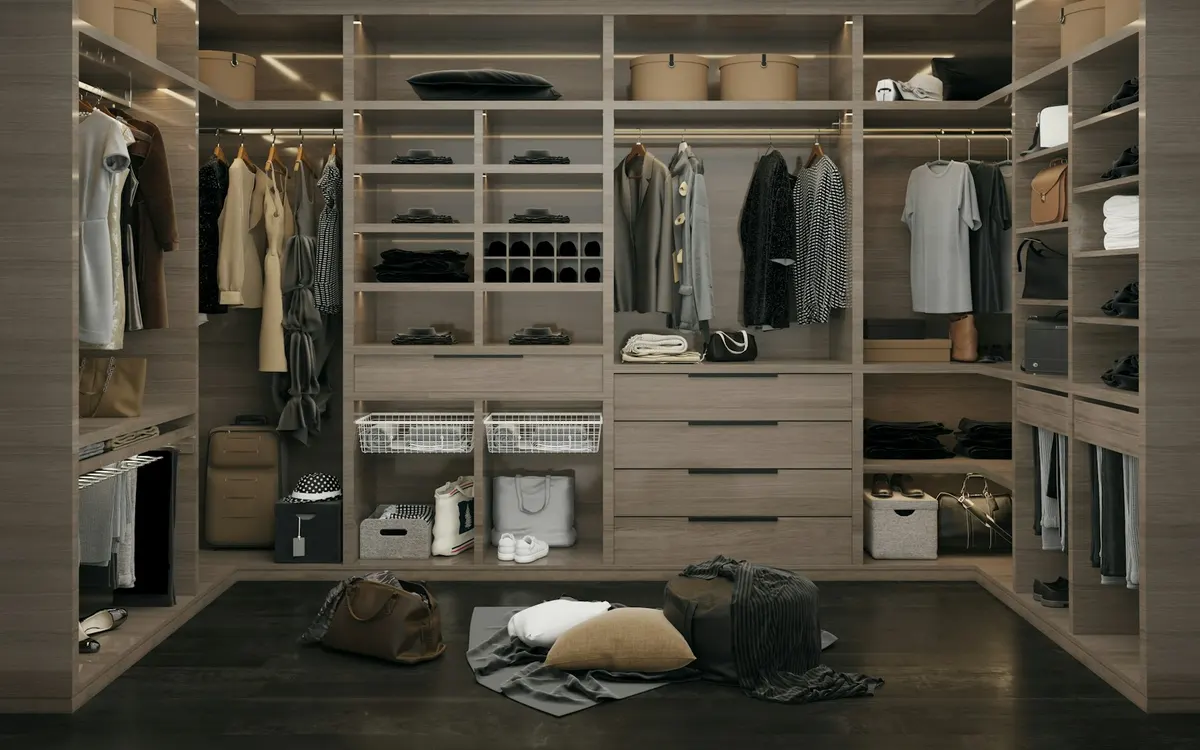
A wardrobe organiser only works if it fits the wardrobe and matches how the garment behaves. Measure the internal height, width and depth first, then decide how much of that volume is hanging space, shelving and drawers, and only then choose fittings: hanging shelf towers for knitwear, shallow dividers for small items, shelf risers for dead height, and rigid lidded boxes for the top of the wardrobe. Almost every organiser that gets returned failed on a measurement, not on quality.
Measure the inside before you buy anything
Retail listings describe the organiser. Nothing describes your wardrobe except a tape measure, and five numbers decide what will fit.
- Internal width, measured between the side panels, not across the doors.
- Internal depth, front to back, taken behind any door frame or hinge.
- Hanging drop, from the underside of the rail to whatever is below it.
- Top gap, from the top shelf to the ceiling of the wardrobe or the room.
- Door opening, the actual clear width when the door is open, which on a hinged wardrobe is narrower than the carcass and on a sliding wardrobe is roughly half of it.
Two of those catch most people out. A rail needs enough depth for shoulders to hang square: measure your own hangers across the shoulders and add clearance, because a wardrobe shallower than that forces a front-facing rail, which holds far fewer garments per metre. And a sliding-door wardrobe never gives you full access, so a wide organiser that fits the carcass may not pass through the opening.
Photograph the space with the tape measure in shot and keep the numbers on your phone. That single note prevents most repeat purchases.
Hanging, shelves and drawers: what each is for
Storage type follows garment behaviour, not tidiness.
| Garment | Best storage | Why | Common mistake |
|---|---|---|---|
| Shirts, dresses, jackets, tailoring | Hung on shaped hangers with a finger of space between | Creasing and shoulder shape | Several garments on one hanger |
| T-shirts, jeans, leggings, nightwear | Folded upright in a drawer so each piece is visible | Stacks hide the lower two-thirds | Tall stacks on a deep shelf |
| Knitwear and jumpers | Folded on a reachable shelf or in a hanging shelf tower | Hanging stretches the shoulders | Hung on the rail |
| Underwear, socks, ties, belts | Shallow drawer with dividers | Small items migrate without walls | Lidded boxes for daily items |
| Occasion and off-season wear | High shelf, breathable bags or lidded boxes, labelled | Rarely reached, needs protection | Mixed into the daily rail |
| Bags and hats | Shelf or shelf divider, upright, not squashed | They lose shape under weight | Hung on a hook by the strap |
Height then decides access. The band between eye and hip is for daily wear. Above eye level goes light, occasional stock. Below knee height goes shoes, bags or heavy folded items. Anything you use every day that sits outside the eye-to-hip band is the reason a wardrobe stops working.
If a shelf is deeper than roughly forty centimetres, put a basket or box on it, or the back row will disappear within a month.
Wardrobe organiser types, and what each is genuinely good for
This is where the money goes, so it is worth being specific about what each type solves.
| Organiser | Genuinely good for | Where it fails |
|---|---|---|
| Hanging shelf tower | Turning a metre of hanging drop into five or six shelves for knitwear and jeans | Sags and leans if overloaded; blocks the rail behind it |
| Shelf divider | Keeping bags, folded stacks and hats upright on a wide shelf | Needs a shelf of the right thickness; useless on wire shelving |
| Shelf riser or stacking shelf | Splitting the dead height above a stack of folded clothes | Only worth it where the gap is genuinely wasted |
| Drawer divider or shallow insert | Underwear, socks, ties, small accessories | Fixed dividers waste the corners; measure the drawer base |
| Second hanging rail | Doubling capacity for shirts, tops and trousers | Only works where garments are short; kills long-hanging space |
| Slim pull-out basket | Narrow gaps beside a rail; laundry-bound items | Needs runners and a clear gap; awkward to retrofit |
| Trouser or scarf hanger | Many similar items in one narrow slot | Everything on one hanger becomes a single unusable lump |
| Over-door hook rack | Bags, belts, a dressing gown | Stops the door closing cleanly on most wardrobes |
| Vacuum bag | Bulky off-season textiles | Not for down, wool knitwear or leather over long periods |
| Rigid lidded box | The top of the wardrobe, and the wardrobe floor | Useless unless labelled on the face you see |
The rule that saves the most money: an organiser earns its place only when it separates a category or recovers dead height. Anything that adds a lid, a clip or an extra movement to something you touch daily will be abandoned by the second week.
For which container materials suit textiles in general — plastic against damp, fabric on shelves, breathable baskets — see the guide to storage boxes. This page covers only what is specific to a wardrobe. Dividers by drawer type are in drawer organisers.
Boxes for the top of the wardrobe
The gap above a wardrobe, or above its top shelf, is the most wasted volume in most bedrooms, and it is a genuinely good place for the things you touch once or twice a year.
Measure the height from the top surface to the ceiling and subtract at least five centimetres, because you have to tilt a box to get it down. Measure the depth of the wardrobe top as well, since a box that overhangs the front looks unstable and usually is. Then match the box to the height: one tall box is harder to handle overhead than two shallow ones, and a lid you lift is safer up there than one you unclip on four sides.
Three rules for that height specifically. Keep every box light enough to lift down at arm's length while standing on the floor or on a stable step — never heavy, dense contents such as books or paperwork above head height. Choose rigid boxes rather than soft ones, because a collapsible box deforms as you lift it and tips its contents onto you. And label the face that points into the room, since the lid is invisible from below.
What belongs up there: off-season bedding, holiday clothes, occasion wear, empty luggage, sentimental textiles. What does not: anything you need in a hurry, anything heavy, and anything even slightly damp, which will stay damp inside a sealed box.
The wardrobe floor, and shoes
The floor of a wardrobe silts up faster than any shelf because it is the easiest place to drop something. Give it a job or it will invent one.
The good uses are a shallow shelf or riser at floor level, a pair of low lidded boxes on the base, or a slim pull-out. The bad use is loose shoes, which spread, tip over and collect dust in the one place you cannot see. Where shoes must live in the wardrobe, put them in a rack or in shallow boxes so the pairs stay pairs; the alternatives are compared in shoe storage ideas. Bulky off-season items usually do better in a bed with storage than on the wardrobe floor.
What fails, and why
- Buying the organiser before measuring. Half of returns are a centimetre problem, not a quality problem.
- Filling the wardrobe to capacity. Keep ten to twenty per cent of the rail and shelf space empty, or clean laundry has nowhere to land and stays in the basket.
- Adding a lid to a daily category. Every extra movement on a daily item is a tax the household eventually refuses to pay.
- Deep shelves without containers. The back row becomes archaeology.
- Hanging knitwear. It stretches at the shoulders and does not recover.
- One hanger for six pairs of trousers. The bottom four are never worn.
- Over-door racks on a door that then will not shut. The wardrobe stops closing, and the room reads as chaotic.
- Storing anything unwashed. Body oils and food traces are exactly what attracts pests.
Safety, moths and ventilation
A tall or freestanding wardrobe should be secured to the wall. RoSPA's advice on accidents to children is direct on this point: furniture at risk of being pulled over should be secured to the wall, and drawers make an inviting climbing frame for a small child. Its guidance on fixing to plasterboard is that brackets should be attached to the underlying wooden studs, so find the stud rather than trusting the board, and get a competent installer if you are not sure what the wall is. Load the bottom of the wardrobe first, keep the heaviest boxes low, and re-check the fixing after any house move.
Clothes moths are the other wardrobe-specific risk, and they are worth understanding rather than fearing. English Heritage's guidance is that it is the larvae, not the adult moths, that do the damage, feeding on keratin-rich natural materials — wool, fur, feathers and skins — and that the insects shun light and dislike disturbance, which is exactly why the dark, undisturbed bottom of a wardrobe is where infestations begin. Their prevention advice is practical: vacuum regularly around the bottom and edges of the wardrobe, disturb hanging clothes by shaking them roughly monthly, store vulnerable textiles in vacuum bags or boxes with tightly sealed lids, and empty the vacuum into a sealed bag that leaves the house. For items already affected, they recommend sealing them in freezer bags at minus eighteen degrees for at least two weeks, which kills every life stage at once.
Ventilation follows from the same logic. Store everything clean and completely dry, never seal a garment that is even slightly damp, and leave a little air around the contents rather than compressing the rail solid.
Small wardrobes and rented rooms
In a small wardrobe, go full height and keep only the current season inside. A second rail doubles capacity for shirts and folded-over trousers; a hanging shelf tower converts the rest of the drop into shelves. Move off-season clothes out entirely, into labelled breathable bags or vacuum storage bags, under the bed or on top of the wardrobe. If the room itself is the constraint rather than the wardrobe, the wider options are in storage ideas for small spaces and bedroom organisation.
Renting adds one rule: choose freestanding and reversible fittings, and still anchor anything tall, agreeing the fixing with the landlord rather than skipping it.
A three-minute weekly reset
- Gather empty hangers at one end of the rail.
- One small box for repairs and one bag for exits, both dated.
- Put clean laundry away before the next wash starts.
- Return anything that has migrated to the wardrobe floor.
- Run a short review at the start of each season, not the end.
Quick checklist
- Internal width, depth, hanging drop, top gap and door opening measured.
- Hanging, shelf and drawer space allocated by garment behaviour.
- Daily wear inside the eye-to-hip band.
- Organisers chosen only where they separate a category or recover dead height.
- Top-of-wardrobe boxes rigid, light, labelled on the front face.
- Ten to twenty per cent of the space left empty.
- Tall or freestanding wardrobe secured to the wall.
- Everything stored clean and dry.
If the fold is the weak point and drawers keep collapsing into a heap, the Marie Kondo folding guide turns them into rows you can read. If the real problem is how much is in there, start with the decluttering guide, then build a smaller coordinated set with the capsule wardrobe guide.
Sources and references
Frequently asked questions
Questions before you begin
What should I measure before buying a wardrobe organiser?
Five numbers: internal width between the side panels, internal depth behind the hinges, the hanging drop under the rail, the gap above the top shelf, and the clear door opening. The door opening is the one people forget, because a hinged door narrows it and a sliding door gives you roughly half the carcass at a time.
Which wardrobe organisers are actually worth buying?
The ones that separate a category or recover dead height: a hanging shelf tower for knitwear, shallow dividers for socks and underwear, shelf dividers to keep bags upright, a second rail where garments are short, and rigid lidded boxes for the top. Anything that adds a lid, a clip or an extra movement to a daily item gets abandoned within a fortnight.
What size storage boxes fit on top of a wardrobe?
Measure from the top surface to the ceiling and subtract at least five centimetres, because you have to tilt the box to lift it down, then check the depth so nothing overhangs the front. Two shallow boxes are easier and safer to handle overhead than one tall one. Rigid boxes only — a collapsible box deforms as you lift it.
What should I store on top of the wardrobe?
Light things you reach once or twice a year: off-season bedding, holiday and occasion clothes, empty luggage, sentimental textiles. Keep dense loads such as books and paperwork below head height, and never store anything even slightly damp in a sealed box up there.
How do I organise a small wardrobe?
Go full height, keep only the current season inside, and convert the drop you are not using: a second rail for shirts and folded trousers, or a hanging shelf tower for knitwear. Move off-season clothes out entirely into labelled breathable bags or vacuum bags, and store shoes elsewhere so the wardrobe floor stays clear.
Should clothes be folded or hung?
Hang anything whose shape matters or that creases badly — shirts, dresses, jackets and tailoring — on shaped hangers with a finger of space between them. Fold knitwear, jeans, T-shirts and nightwear, upright in a drawer rather than in stacks, so every piece stays visible. Hanging jumpers stretches the shoulders and they do not recover.
How do I stop moths getting into my wardrobe?
English Heritage’s advice is that the larvae do the damage, feeding on wool, fur, feathers and skins, and that the insects shun light and dislike disturbance. Vacuum around the bottom and edges of the wardrobe regularly, shake hanging clothes about once a month, store vulnerable textiles in vacuum bags or tightly sealed boxes, and store everything clean, since body oils and food traces are what attract them.
Does a wardrobe need to be fixed to the wall?
A tall or freestanding wardrobe should be secured to the wall. RoSPA advises that furniture at risk of being pulled over should be secured, and that drawers make an inviting climbing frame for a small child. On plasterboard its guidance is to fix into the underlying wooden studs, so find the stud rather than trusting the board, and use a competent installer if you are unsure of the wall.


