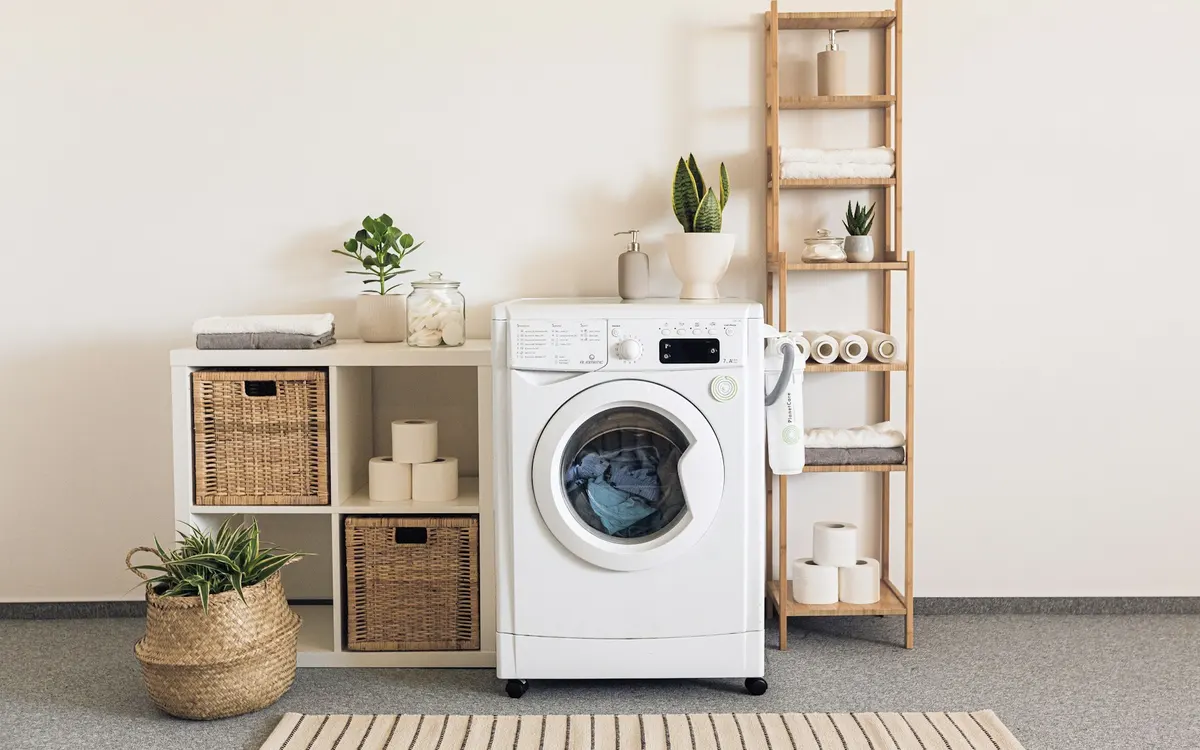
Small utility room ideas work best when the room is designed around the laundry cycle rather than around the appliances. Follow the sequence — collect, sort, treat, wash, dry, fold, put away — and find the stage that currently has no home, because that is where the pile always forms. In a small UK utility that usually means a folding surface, somewhere to dry indoors without causing damp, and a return route so clean clothes actually leave the room. Fix those three and the layout mostly designs itself.
Design around the cycle, not the appliances
Most utility rooms are planned as a place to put a washing machine, which is why so many end up with a permanent heap on the floor. Laundry is a seven-stage process, and every stage needs somewhere to be.
- Collect. Dirty clothes leave bedrooms and bathrooms and arrive somewhere.
- Sort. They are separated into the categories you actually use.
- Treat. Stains and delicates get attention before the drum.
- Wash. The machine cycle itself.
- Dry. Line, airer, dryer or a combination.
- Fold. A flat surface, however small.
- Put away. Clothes return to the rooms they came from.
Walk your own cycle and mark the stage with no home. In most small utilities it is folding or putting away, which is why the real bottleneck is almost never the washing. A clean load with nowhere to be folded becomes a chair pile, and a folded load with no return route becomes a basket that lives on the landing.
Layouts that work in a small UK utility
| Layout | Best for | Watch out |
|---|---|---|
| Single wall | Narrow rooms and galley kitchens | No worktop unless machines sit under one; plan a fold-down surface |
| Galley, two facing walls | Rooms over about 1.8 m wide | Needs clear floor between; the door swing eats one end |
| Tall cupboard utility | Kitchens with no separate room | Ventilation and vibration matter more than looks |
| Under-stairs utility | Homes with a plumbed run nearby | Sloping height limits appliance and door clearance |
| Utility as boot room | Back doors, gardens, dogs, muddy kit | Wet outdoor gear and clean laundry need separating |
| Stacked appliances | The smallest footprints | Needs a proper stacking kit and reachable controls |
The under-stairs option is common in UK homes and has its own height and access rules, set out in under stairs storage ideas. Where the room doubles as a back door and boot room, keep the two functions physically separate: wet coats and muddy boots need hooks, a drip tray and a wipeable floor, while clean laundry needs a surface it will not be contaminated on. A deep utility sink earns its space only if you regularly soak, hand-wash or fill buckets; otherwise that space does more good as worktop.
Appliance practicalities you cannot copy from a photograph
Door swing. A front-loader door swings a long way and usually only one way. Measure the arc before deciding which side of the room the machine goes, and check you can still open the room door with the appliance door open.
Stacking. A dryer on top of a washer must sit on a stacking kit made for those appliances, not simply be placed there. Washing machines vibrate hard on spin, and an unsecured stack can walk or topple. Check the controls stay reachable and readable once stacked.
Integrated or freestanding. Integrated appliances look calmer but are usually smaller in capacity, dearer to replace and harder to pull out for repairs. Freestanding units are cheaper and easier to service but need a visible gap.
Plumbing and waste. A machine needs a supply, a waste connection and a socket that is not behind the appliance. Moving plumbing is the expensive part of any utility plan, so design around the existing connections where you can.
Dryer type. Vented dryers need a duct to the outside, so their position is fixed by where that duct can go. Condenser dryers can go anywhere but put heat and moisture into the room. Heat-pump dryers are gentler and use less energy but run longer cycles. These are genuinely different rooms to plan, which is why copying a layout without knowing the dryer type goes wrong. Whatever the machines, check the room can lose moist air and that any vent is not blocked by the shelving you are about to add.
Give folding a surface, even without a worktop
Folding needs a flat, clean, waist-height surface roughly the width of a towel. If there is no worktop, create one. A worktop over front-loading appliances is the neatest answer where the machines fit under. Where they do not, a wall-mounted fold-down surface on sturdy brackets works well and disappears when not in use. A slim pull-out board, a board that sits over the sink, or a shelf across the top of stacked appliances can all serve.
If none of that is possible, name a surface elsewhere — the end of a kitchen worktop, the dining table — and treat it as the folding station rather than pretending it does not exist. The surface only works if it stays clear: a folding surface used as a shelf is not a folding surface.
Drying indoors without causing damp
Drying clothes indoors is normal in a British winter, and it puts a substantial amount of water into the air. That moisture has to go somewhere, and if it condenses on cold walls and windows it causes damp and mould.
The rules are simple. Dry in one room rather than spreading airers through the house. Keep the door to that room closed so moist air does not travel. Ventilate that room while clothes dry, using an extractor fan, a window on a vent setting or a dehumidifier. Do not dry clothes on radiators in a closed, unventilated room, which is the fastest route to streaming windows.
A heated airer or a dehumidifier used alongside a rack will usually dry a load faster, and with less moisture escaping, than an unheated rack in a closed room. Spin the load thoroughly first, because water removed by the machine is water that never enters the air.
Storage, and where cleaning products belong
In a small utility, the walls do the work. Above the appliances, fit a shelf or wall cupboards for detergent, spare bulbs and cloths, keeping a hand's clearance above a machine that vibrates and never blocking a vent or meter. Beside them, use narrow pull-outs in any gap wider than about 15 cm for bottles and brushes. Behind the door, a slim rack takes sprays and cloths. Hang the ironing board, mop and brush rather than leaning them, so the floor stays clear.
Use a small number of repeated containers rather than many different ones. Shelf loads and wall fixings matter here as much as anywhere, and are covered in shelving ideas; the containers themselves are covered in storage boxes.
Keep every cleaning and laundry product in its original labelled container with the cap closed, and never decant chemicals into unlabelled bottles. Where children live in or visit the home, laundry capsules deserve particular care, because they are colourful and soft and attractive to small children: keep them high up or in a lockable cupboard, out of sight and reach, along with bleach and any concentrated cleaner.
Where the laundry basket goes
The basket belongs where clothes are taken off, not where they are washed. One basket per bedroom or bathroom removes the daily carry, and a single basket in the utility for sorting is enough.
For the return journey, use one basket per destination so clean clothes leave the room in one trip. This is the step that most often fails, and it is worth attaching to an existing habit rather than leaving to willpower; the weekly rhythm in how to keep the house tidy covers how, and the far end of the journey is in wardrobe organisation.
A maintenance rhythm and a small-utility checklist
- Clean the dryer lint filter after every load, and empty a condenser dryer's water tank as directed.
- Wipe the washing machine door seal and leave the door ajar so it dries.
- Run a hot maintenance wash roughly monthly, or as the manual states, and clean the detergent drawer when residue appears.
- Check hoses and the floor behind the machine for drips each season.
- Confirm every stage of the cycle has a named place, especially folding and putting away.
- Confirm the appliance door swing and the room door swing do not collide.
- Confirm there is a ventilated place to dry indoors with the door closed.
- Confirm products stay in labelled original containers, high or locked where children are around.
- Finish one load completely before starting several more.
Once the cycle has a home, the next gain comes from the other end of the journey: read wardrobe organisation so clean clothes have somewhere obvious to land, then the house cleaning schedule to fix the weekly rhythm that keeps the room from silting up again.
Frequently asked questions
Questions before you begin
How do I fit a utility room into a small space?
Design around the existing plumbing and the laundry cycle rather than around the appliances. A single-wall layout, a tall utility cupboard or an under-stairs run all work if the appliance door swing, a folding surface and a ventilated drying spot are planned in from the start.
Can I stack a washer and dryer?
Yes, but only using a stacking kit made for those appliances, never by simply placing one on the other. Washing machines vibrate hard on spin, so the stack must be secured, and the controls on both machines need to stay reachable and readable.
Where should the laundry basket go?
Where clothes are taken off, not where they are washed. One basket per bedroom or bathroom removes the daily carry, with a single sorting basket in the utility, and one basket per destination for the return journey so clean clothes leave in one trip.
How do I dry clothes indoors without damp?
Dry in one room with the door closed and that room ventilated, using an extractor fan, a window vent or a dehumidifier. Spin the load thoroughly first, and avoid spreading airers through a closed, unventilated house, which is what causes condensation on windows and mould on cold walls.
What should I store in a utility room?
Laundry products, cleaning kit, cloths, the iron and ironing board, the hoover, spare bulbs and outdoor or pet gear if the room doubles as a boot room. Keep chemicals in their original labelled containers, and keep laundry capsules high or locked where children live or visit.
How many laundry baskets are useful?
Only as many as your actual sorting and return routine needs. For most households that means one per bedroom or bathroom for collection, plus one or two in the utility for sorting and returning.
Do I need a sink in a small utility room?
Only if you regularly soak, hand-wash, rinse muddy kit or fill buckets. If none of those happen often, the same space usually does more good as a worktop for folding.


