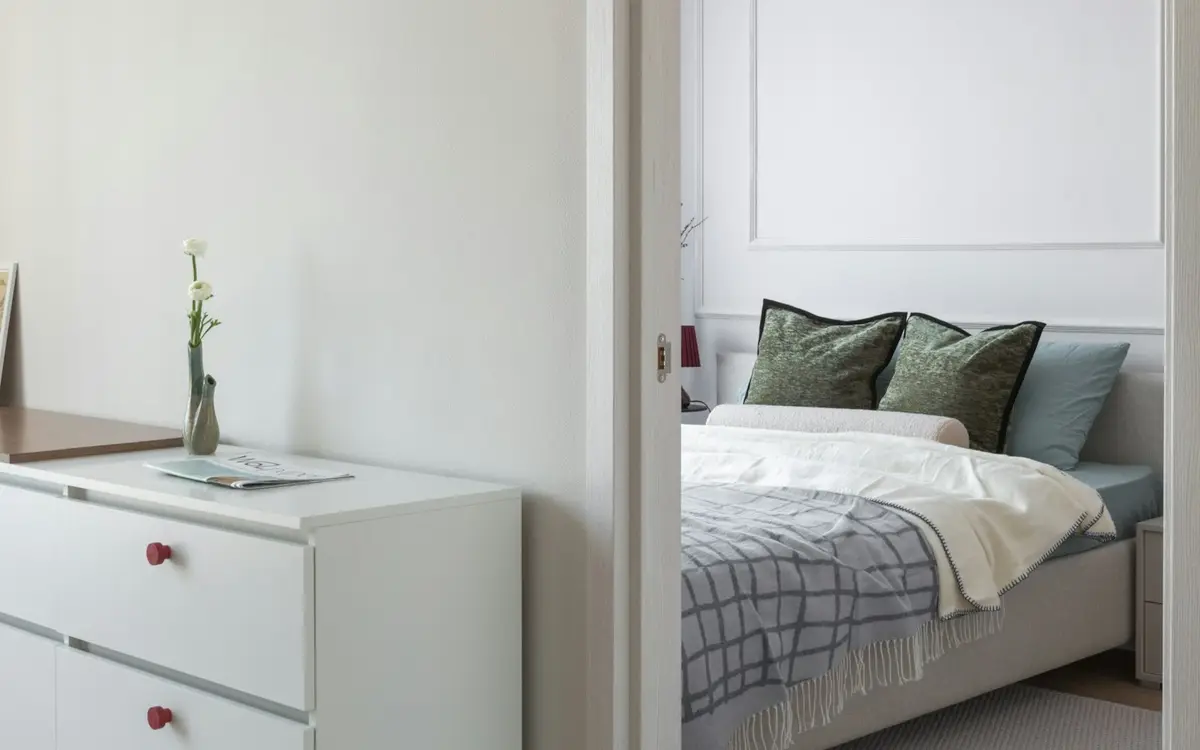
A bed with storage earns its price when the thing going inside is bulky, dry and needed a few times a year: spare duvets, pillows, suitcases, off-season clothes. Ottoman beds lift the whole base on gas struts and hold by far the most; divan drawers hold much less but open in two seconds; cabin and mid sleeper beds buy a child a desk or a wardrobe under the mattress. The decision is rarely about capacity. It is about the clearance the mechanism needs, the weight of your mattress against the lift, and whether the base can breathe.
The six types, and what each one is actually for
An end-lift ottoman hinges at the head and raises the entire base, mattress included, on two gas struts. One open compartment the size of the bed holds several times what any drawer arrangement does, but every retrieval is a two-handed job needing a clear arc above the bed. A side-lift ottoman hinges along one long side instead, which suits rooms where the foot of the bed faces a wall or a radiator, but only moves the clearance problem sideways.
A divan with drawers is the traditional answer: two drawers on one side or one on each, or four meaning two per side. The compartments are shallow — folded clothes, towels, shoes in boxes — and separate, which is exactly what you want for categories you dip into monthly. A bed frame with built-in drawers does the same under a slatted deck rather than a solid divan base; the drawers are often shallower, but air moves through the slats above them, which matters more than most buyers expect.
A cabin bed or mid sleeper raises the sleeping surface far enough to fit drawers, a cupboard, a desk or a pull-out underneath, and comes with rules a normal bed does not. A day bed sits against a wall with a back and two sides, and takes either a trundle guest mattress or drawers underneath — almost never both.
| Type | What opens | Realistic contents | Clearance needed | Where it fails |
|---|---|---|---|---|
| End-lift ottoman | Whole base, gas struts | Duvets, suitcases, off-season clothes | Clear arc above the bed, standing room at the foot | Sloped ceilings, heavy mattresses, far corners |
| Side-lift ottoman | Whole base, one long side | As end-lift | Clear floor along one full side | Beds walled in on both sides |
| Divan, 2 drawers | Two shallow drawers | Bedding sets, towels, folded clothes | Drawer depth plus body width | One drawer blocked by a wardrobe |
| Divan, 4 drawers | Four shallow drawers | Categories used monthly | Clear floor both sides | Small rooms with one side to a wall |
| Frame with drawers | Drawers under a slatted deck | Shoes, folded clothes, kit bags | As divan drawers | Deep-pile carpet dragging the base |
| Cabin or mid sleeper | Drawers, cupboards, pull-outs | A child’s clothes, toys, desk kit | Headroom and a safe route up | Anchoring, minimum age, heavy contents |
Clearance is the number people forget
Capacity is printed on the label. Clearance is not, and it is what decides whether the storage gets used.
An end-lift ottoman platform swings through a wide arc and finishes close to vertical, so the space it needs above the bed is roughly the length of the base. A sloping eave, a loft conversion ceiling, a low pendant light or a shelf above the headboard can stop it dead. Measure from the mattress top to the nearest obstruction and compare it against the manufacturer’s own opening diagram. Then check you have somewhere to stand at the opening end, because the platform has to be guided back down rather than dropped.
Divan drawers need clear floor equal to the drawer’s depth plus room for your body: in most bedrooms, 60 to 80 cm beside the bed. If the wardrobe doors open into that strip, one of the two never happens. Flooring matters too: many divan drawers run on small wheels or glide directly on the floor, so deep-pile carpet and thick underlay raise the drawer, add drag and can stop it closing flush. A hard floor is kinder to every drawer design.
Mark the open positions on the floor with masking tape before you order — the same test used in storage furniture, which also covers under-bed boxes, ottoman furniture and sofa beds as pieces in their own right.
Bed sizes as sold in the UK, and what changes
UK beds are sold under imperial names — 3'0" single, 4'0" small double, 4'6" double, 5'0" king, 6'0" super king — with each retailer publishing its own metric equivalent. Read that metric figure from the maker rather than converting the name, because the National Bed Federation is explicit that there is "no legal standard on size tolerances for mattresses and divan bases in the UK", with accepted practice being plus or minus 20 mm on the stated length and width. Two centimetres of slack matters when a drawer has to clear a radiator.
Size then changes the storage in two ways. Reach first: a single ottoman gives one long, narrow box you can lean across from either side, while a king or super king gives an area you physically cannot cross, so the far corners become a dead zone for the categories you touch least. Then drawer arithmetic. Four-drawer divans are normally offered from double upwards; singles and small doubles usually get two. In a small double squeezed into a box room, a four-drawer base is often a worse buy than a two-drawer one, because the drawers on the wall side are permanently unusable and you have paid for them anyway.
Mattress weight against the lift mechanism
This is the commonest complaint about ottoman beds and it has a boring cause. Gas struts are rated for the platform plus a mattress inside a stated weight range. Put a heavy pocket-sprung king on struts specified for a lighter mattress and the base is hard to raise and drops faster than you can control. A light foam mattress on strong struts will not stay shut. Read the mattress weight and check it against the bed’s specification before buying either.
Treat a failing mechanism as a safety issue, not an annoyance. In October 2024 a senior coroner issued a Prevention of Future Deaths report after a woman "leaning over the storage area of an Ottoman-styled 'gas-lift bed'" was killed when "the mattress platform descended unexpectedly, trapping her neck against the upper surface of the side panel". The inquest found "one of the two gas-lift pistons was defective", and the coroner named "the existence and use of gas piston bed mechanisms whose failure presents risk to life" as a matter of concern, writing to the Office for Product Safety and Standards.
The practical rules follow. Never let a child open the bed or reach into the compartment. Do not put your head or torso inside while the platform is raised — kneel outside and reach in. Stop using a mechanism that drops unevenly or will not hold itself up, and keep the instructions, because strut replacement is a stated part number.
Damp, ventilation and the sealed base
A person breathing and perspiring for eight hours puts moisture into the bed above the compartment, and the underside of a solid platform is often the coldest surface that moisture meets. Government guidance on damp and mould explains the mechanism: condensation damp "happens when moisture generated inside the home cools and condenses onto colder parts of the buildings", and "if a dwelling is inadequately ventilated, moisture in the air cannot escape the building and is therefore more likely to cause condensation". The same guidance advises leaving a gap between furniture and external walls — which applies to a bed pushed hard into a cold corner.
So choose a slatted or vented base where you can, check that the ventilation holes in an ottoman platform exist, and do not cover them with the boxes you put inside. Store textiles clean and completely dry, and open the compartment every time you change the bedding. If you find condensation, a musty smell or black spotting inside, empty it, dry it and deal with the room — the same guidance is clear that "it is totally unreasonable to blame damp and mould in the home on 'lifestyle choices'", and a storage bed against a damp wall hides a building fault rather than solving it. The wider airflow logic sits in bedroom organisation.
Children: cabin beds, mid sleepers and the rules that matter
Raised children’s beds are the one category here governed by law and by a published standard, so read both rather than a retailer’s blog. BS EN 747-1:2024, "Furniture. Bunk beds and high beds. Safety, strength and durability requirements", published on 31 March 2024, applies where the upper surface of the bed base sits 600 mm or more above the floor — exactly where cabin beds and mid sleepers land. Separately, the Bunk Beds (Entrapment Hazards) (Safety) Regulations 1987 make it an offence to supply a bunk bed built so that "any part of the body of a child under six years of age" could become "wedged or trapped" at or above the sleeping surface, specifically to prevent "strangulation, suffocation or injury to the neck or spinal column". Those regulations also fix permissible gaps at not more than 75 mm in the sleeping surface, and elsewhere not less than 60 mm nor more than 75 mm: a gap must either be too small to admit a limb or too large to trap one.
For the minimum age of the raised sleeping level, follow the figure printed on the bed and in its instructions rather than a rule of thumb, because it varies with height and design.
Then anchor it. RoSPA is direct: "Furniture and tall kitchen appliance, at risk from being pulled over, should be secured to the wall", and notes that "sets of drawers, in a child’s eyes, make ideal climbing frames but, if unsecured, they pull over easily". A cabin bed with four open drawers is a staircase. RoSPA also records that falls "account for 44 per cent of all children’s accidents".
Finally, make the storage usable by the child who owns it. Drawers a six-year-old cannot pull open are not storage. One visible category per drawer, light contents, and the sorting logic from toy storage ideas.
Day beds, trundles and corner sofa beds
A day bed forces a straight choice: a trundle for occasional guests, or drawers for storage. Both occupy the same volume, so if guests stay two or three nights a year, drawers give more value the other 362.
A corner sofa bed with storage keeps its box under the chaise, and two checks decide whether it works. Can you still open the box when the bed is out — usually no, because the mechanism occupies the floor in front of it? And does the sofa bed’s own bedding fit inside? If not, you have bought storage that cannot hold the one thing it exists to hold. Sofas and ottomans are compared as furniture in storage furniture.
What not to put in a bed, and how to find it again
Keep out anything you need weekly, anything you might need in a hurry — passports do not belong under a mattress you have to lift — and anything even slightly damp. Chemicals and anything with a smell are a poor idea in a sealed box under your face all night.
What goes in well: spare duvets and pillows, off-season clothing, suitcases, spare bedding sets and the winter or summer half of a wardrobe. Compressed textiles are covered in vacuum storage bags, the containers in storage boxes, and the seasonal swap that feeds the bed in wardrobe organisation.
Findability is the part everyone skips, because nothing about a closed bed reminds you it is there. Give each drawer exactly one category, tape a written contents list inside the ottoman lid, and date it — at the next seasonal swap you can then see what has not moved in two years.
When under-bed boxes are the better answer
A bed with storage is the wrong buy more often than the marketing suggests.
- You rent or move often. Boxes come with you; a divan base often will not go up a communal stairwell or round a landing.
- Your mattress is heavy and you lift alone. An ottoman you cannot raise comfortably is a sealed void.
- The room has sloped eaves or a low ceiling. The platform will not clear.
- Your categories are small and varied. Boxes let you take one out without disturbing anything else.
- Budget is the constraint. The premium over a plain slatted frame buys a lot of boxes and a mattress upgrade instead.
In genuinely small rooms the honest comparison is not storage bed against plain bed, but storage bed against the floor you would free by owning less; storage ideas for small spaces works through that trade-off.
Quick checklist
- Category named and measured before the bed is chosen
- Opening arc or drawer run marked on the floor with tape
- Mattress weight checked against the strut rating
- Ventilation holes present and uncovered, contents dry
- Children’s beds anchored, gaps checked, minimum age read from the label
- Contents list taped inside the lid and dated
Sources and references
- Legislation.gov.uk — The Bunk Beds (Entrapment Hazards) (Safety) Regulations 1987 ↗
- BSI — BS EN 747-1:2024 Furniture. Bunk beds and high beds. Safety, strength and durability requirements ↗
- Courts and Tribunals Judiciary — Helen Davey: Prevention of Future Deaths Report (2024-0533) ↗
- RoSPA — Preventing accidents to children ↗
- GOV.UK — Understanding and addressing the health risks of damp and mould in the home ↗
- National Bed Federation — Regulations and standards ↗
Frequently asked questions
Questions before you begin
Is a bed with storage worth it?
It is worth it when the category going inside is bulky, dry and used a few times a year — spare duvets, suitcases, off-season clothes — and when the room has the clearance the mechanism needs. It is a poor deal for anything you reach for weekly, because every retrieval means lifting a mattress or kneeling on the floor. If the room is tight or your mattress is heavy, under-bed boxes on a plain frame usually work better.
How much can an ottoman bed hold?
An end-lift ottoman opens the whole footprint of the bed, so the compartment is roughly the mattress area by the depth of the base — far more than any drawer arrangement. The practical limit is not volume but reach: on a king or super king you cannot get to the far corners without climbing in. Load the far end with the things you touch least.
How much clearance does an ottoman bed need?
The platform swings up through an arc, so you need clear height above the bed and nothing fixed to the wall in the way — sloping eaves, a low loft ceiling or a shelf above the headboard can all stop it. You also need somewhere to stand at the opening end to guide the platform down. Check the manufacturer’s opening diagram rather than assuming.
Are ottoman gas-lift beds safe?
They are safe when the mechanism matches the mattress and stays in good order, but a failed gas piston is a genuine hazard. A coroner’s Prevention of Future Deaths report in October 2024 followed the death of a woman leaning over the storage area of a gas-lift bed when the mattress platform descended unexpectedly and trapped her neck; one of the two pistons was defective. Never let a child operate or reach into the compartment, do not lean into it while the platform is raised, and stop using the lift if it drops unevenly.
Do storage beds cause damp or mould?
A sealed base can trap the moisture you give off overnight. UK government guidance explains that condensation damp happens when moisture generated inside the home cools and condenses onto colder parts of the building, and that inadequate ventilation stops that moisture escaping. Choose a slatted or ventilated base, keep the vent holes clear, and never store anything that is not completely dry.
What is the difference between a divan with drawers and an ottoman bed?
A divan drawer slides out sideways and takes two seconds, but the compartments are shallow and split into two or four boxes. An ottoman lifts the whole base on struts, holds several times more, and takes both hands and a clear arc above the bed. Drawers suit monthly access; an ottoman suits things you retrieve twice a year.
What age is a cabin bed or mid sleeper suitable for?
Follow the minimum age printed on the bed and in its instructions rather than a rule of thumb, because it varies with the height of the sleeping surface. BS EN 747-1:2024 covers bunk beds and high beds where the upper surface of the bed base sits 600 mm or more above the floor, which is where most mid sleepers and cabin beds fall. UK regulations from 1987 also make it an offence to supply a bunk bed constructed so a child under six could become wedged or trapped at or above the sleeping surface.
Is a bed with storage better than under-bed boxes?
Boxes win when you rent, move often, live with a heavy mattress or need to pull out one category without disturbing the rest, and they cost a fraction of the price difference. A storage bed wins when the floor around the bed is too tight for boxes to slide out, or when you want the space genuinely hidden and dust-free. Many homes are better served by a plain slatted frame and four labelled boxes.


