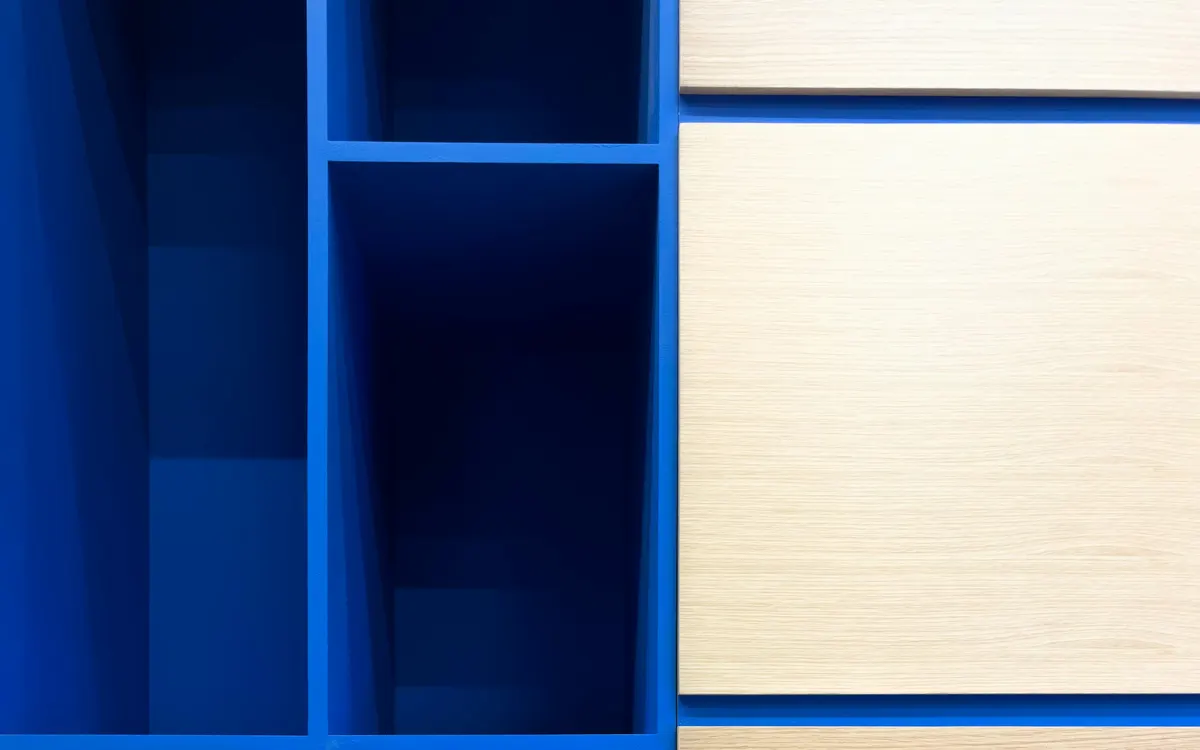
Cube storage works when three decisions are made together: the configuration that fits the wall and the job, the mix of open cubes and closed inserts that controls how busy the room looks, and the fixing that stops the unit tipping. Most cube storage units use an internal cube of around 33 cm, so fabric boxes, drawers and small doors are interchangeable; plan what goes in each cube before you buy inserts, keep heavy items in the bottom row and anchor the unit to the wall, especially where children live.
What a cube storage unit actually is
A cube storage unit is a grid of equal square openings, sold in configurations such as 1x4, 2x2, 2x4 and 4x4, sometimes with a plinth or legs. The strength of the format is that every opening is the same, so you can change what a cube does without changing the furniture: a fabric box today, a drawer next year, an open shelf for books after that. The weakness is the same uniformity, because a wall of identical squares filled with random things looks busier than an ordinary bookcase. The mix of open and closed cubes is the tool that fixes that.
Before buying, measure the internal cube of the unit you are considering, not the external dimensions. Around 33 cm is common, but ranges differ by a centimetre or two, which is enough to stop a box fitting or a record sitting flat. Check the shelf load stated in the instructions and the depth, because shallow units cannot take standard box files or larger toys.
Configurations and what they suit
| Configuration | Typical use | Notes |
|---|---|---|
| 1x4 horizontal | TV stand, bench with a cushion, under a window | Low centre of gravity; check the width clears radiators and sockets |
| 1x4 vertical | Narrow gap, hallway, beside a desk | Tall and narrow, so wall fixing is essential |
| 2x2 | Bedside, children’s room, small living room | Easy to move; good first unit for a renter |
| 2x4 horizontal | Toy storage, low room divider, media wall | Wide top surface for lamps and plants |
| 2x4 vertical | Books and files in a home office, records | Heavy contents go in the bottom two rows only |
| 4x4 | Room divider, library wall, shared living space | Needs a strong wall fixing or a floor fixing when freestanding |
| Stacked units | Whole-wall storage | Only stack if the maker allows it and join the units together |
Choosing the open and closed ratio
Decide the ratio before you decide the inserts. Open cubes suit things worth seeing and reaching daily: books with their spines out, a plant, a basket of current magazines, a record player. Closed inserts suit categories that are visually busy or that children scatter: toys, cables and chargers, paperwork, craft supplies, spare bedding. In most rooms roughly half open and half closed looks calm without hiding everything; in a children’s room the balance moves towards closed, in a home office towards open.
Inserts come in three main types. Fabric boxes are the cheapest and lightest, fold flat and suit toys, textiles and anything soft. Drawer inserts suit small items and paperwork and keep a room looking finished, but they add weight. Door inserts turn a cube into a small cupboard and are useful in a living room where the unit doubles as a media wall. A single row of matching boxes along the bottom often does more for a room than a full set, and the principles in the guide to storage boxes apply to inserts too.
Load, weight and where the heavy things go
Each shelf in a cube unit has a maximum load in the instructions, and it is usually lower than people expect. Records, hardbacks, board games and toolboxes are heavy and belong in the bottom row, spread across several cubes rather than filling one column. Lighter fabric boxes go up top. A unit loaded top-heavy is unstable even when it is fixed, and one loaded past its shelf rating sags in the middle and eventually pulls the joints apart.
If the unit doubles as a bench, check the top load separately and add a cushion sized to the width. If it holds a television, check that the depth and the stated top load suit the set and route cables through the back so nothing pulls the unit forward.
Anchoring against tip-over
RoSPA advises that furniture at risk of being pulled over should be secured to the wall, and points out that sets of drawers look like ideal climbing frames to a child. A cube unit with half-open drawers or a missing fabric box is the same climbing frame, and a tall one is heavier than it looks. Use the wall bracket or strap supplied, or an anti-tip strap fixed to a solid wall or, in plasterboard, to a stud; RoSPA gives the same advice for wall-hung televisions. Fix at the top of the unit, keep the fixing taut and check it whenever you move the unit.
Freestanding room dividers cannot be fixed to a wall in the usual way, so use a low, wide configuration, fix to the floor where possible, keep the heaviest items at the bottom and avoid placing a freestanding tall unit where small children play. Children’s rooms are where this matters most, and it is a core step in the guide to toy storage ideas.
Placement, skirting boards and cables
Most cube units have a flat back and stand off the wall by the depth of the skirting board, which leaves a gap that swallows small toys and makes fixing harder. Either choose a unit with a recessed back or plinth, or fit a batten of the skirting depth behind the top of the unit so the bracket has something solid to reach. Leave a small gap at radiators and check that sockets remain usable, or the unit will be moved every time something needs charging, and moved units are rarely re-fixed.
Cube storage ideas by room
In a living room, a 2x4 or 4x4 unit becomes a media wall: television on top, drawers or doors in the bottom row for cables and consoles, open cubes above for books and objects. In a children’s room, a horizontal 2x4 with fabric boxes at child height and open cubes for favourite books keeps tidying possible without help. In a bedroom, a 1x4 under the window becomes a bench with a cushion and four boxes of out-of-season layers. In a home office, a vertical 2x4 takes box files low and reference books high. In a hallway, a 1x4 on its side holds a box per person for shoes or bags. The wider comparison with fixed shelves sits in shelving ideas and living room storage ideas.
Renters and moving house
Cube units suit renters because they stand on the floor and travel well, but the wall fixing still matters. Ask permission for one screw hole per unit, which most landlords accept, and fill it on leaving. Where drilling is refused, keep to low configurations, load the bottom row heavily, and do not use a tall unit as a room divider in a home with young children. When moving, empty the unit completely; a loaded cube unit racks and loosens at the joints if it is carried.
Quick checklist
- Internal cube and shelf load checked against the exact unit
- Configuration chosen for the wall, the job and the room
- Open and closed cubes planned, roughly half and half in most rooms
- Heavy items in the bottom row, spread across cubes
- Wall bracket or anti-tip strap fixed into solid wall or stud
- Skirting gap solved with a plinth or batten
- Sockets and radiators still usable
If the plan calls for more than one unit, it is worth comparing cube storage with other freestanding options first. Continue with the guide to storage furniture.
Sources and references
Frequently asked questions
Questions before you begin
What size are cube storage units?
Most mainstream units use an internal cube of around 33 cm, sized so fabric boxes, drawers and doors are interchangeable, but dimensions vary between ranges. Measure the internal opening of the unit you own before buying inserts.
Can cube storage hold books and records?
Usually yes in the bottom rows, provided you respect the maximum load per shelf in the instructions. Records and hardbacks are heavy, so keep them low and spread across cubes rather than filling one column.
Should a cube storage unit be fixed to the wall?
Yes. UK child safety guidance advises securing furniture that could be pulled over to the wall, and a cube unit becomes a climbing frame the moment the inserts are half out. Use the supplied bracket or an anti-tip strap fixed into a solid wall or stud.
Can I use cube storage as a room divider?
Yes, a 2x4 or 4x4 unit works well, but a freestanding unit cannot be wall-fixed in the usual way. Fix it to the floor, use a low and wide configuration, keep the heaviest items at the bottom and avoid it where small children play.
How many cubes should be open or closed?
Around half open and half closed keeps a room calm without hiding everything. Use open cubes for items you want to see or reach daily and closed inserts for toys, cables, paperwork and anything visually busy.


