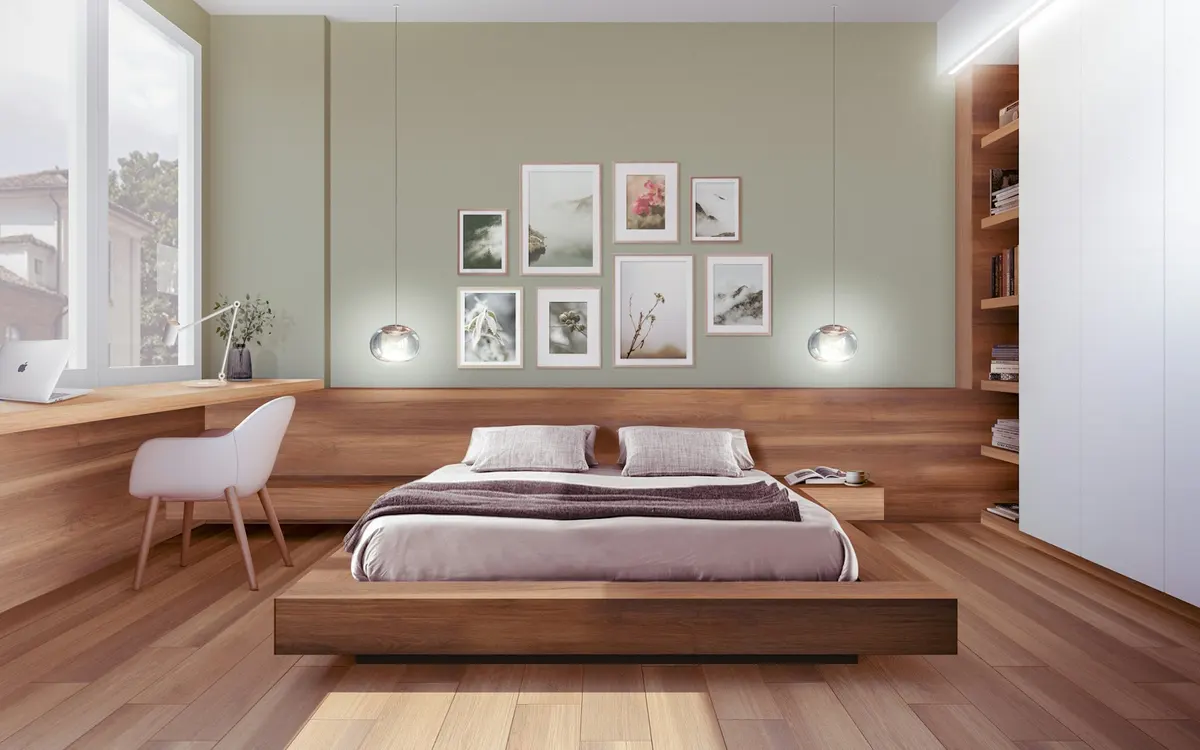
Bedroom storage works best when you rank the volumes the room already has instead of buying furniture and hoping it fits. In most UK bedrooms the order by capacity runs: the wardrobe interior, the space under the bed, the wall above the furniture, the top of the wardrobe, the back of the door, the window reveal, and last of all the corner. Take the volumes that cost no floor area first, and add a floor-standing piece only when those are genuinely full. In a box room the list runs out quickly, and the honest answer becomes owning fewer clothes rather than buying more storage.
Rank the volumes before you buy anything
A bedroom is usually described by its floor area, which is the least useful number in it. What decides whether the room works is how much of its volume is doing something:
| Volume | Roughly what it holds | Costs floor area | What to watch |
|---|---|---|---|
| Wardrobe interior | Most of a household's clothes | Already spent | Dead air above the rail and below hanging garments |
| Under the bed | Two to four flat boxes, or a whole ottoman base | No | Frame clearance, dust and airflow |
| Wall above furniture | Books, folders, boxes, framed things | No | Wall type decides the fixing, not the bracket |
| Top of the wardrobe | Suitcases, off-season bedding | No | Only what you can lift down safely |
| Back of the door | Shoes, bags, belts, a dressing gown | No | Over-door racks stop some doors closing |
| Window reveal | A narrow shelf, or a seat with storage under it | Very little | Radiator, curtain track and the opening casement |
| Corner | An awkward triangle nothing squares up to | Yes | Diagonal furniture usually wastes more than it gains |
The order matters because the first four cost nothing in floor area and the last costs the most. Most people buy in reverse: a corner unit, then a chest of drawers, while the top 40 cm of the wardrobe sits empty and the wall above the bed carries one picture.
Before spending anything, take four measurements: the internal height above the hanging rail, the clearance under the bed frame at its lowest point, the depth of the window reveal, and the free wall above each piece of furniture. They will tell you more than an afternoon of browsing.
The wardrobe interior is the biggest win and the least glamorous
Nothing else comes close. A standard double wardrobe holds more usable volume than every other idea on this page combined, and in most homes a third of it is air: hanging set to the longest coat rather than to shirts, one folded jumper on the shelf above the rail, shoes at random on the floor.
The inside of the wardrobe has its own guide — wardrobe organisation covers rail heights, double-hanging, drawers, shelf depth and which organisers earn their place.
The point here is sequence. Fix the wardrobe interior before buying anything new, because the space you recover is free, invisible and often larger than the furniture you were about to buy.
Under the bed: the second-largest volume in the room
Under a standard UK double there is roughly a square metre and a half of floor with 12 cm to 30 cm of headroom above it, depending on the frame — real capacity, already inside the footprint you have paid for.
Three ways to use it, in descending order of capacity. A bed whose base is the storage holds the most; ottoman lifts, divan drawers and cabin beds are compared in beds with storage. Flat lidded boxes on castors come next; ottomans and under-bed boxes as furniture are in storage furniture, and the containers themselves in storage boxes. Loose items on the carpet are not storage at all.
Three rules apply whatever the method. Measure the clearance at the lowest point, not the highest, because most frames have a central rail sitting lower than the sides. Give the space one named category — spare bedding, off-season clothes, one suitcase — rather than treating it as overflow. And keep it breathable: government guidance on damp and mould notes that moisture generated inside the home condenses onto colder parts of the building, and that leaving a gap between furniture and external walls helps reduce the risk. Store textiles clean and dry, leave a gap at the wall, and open the window daily.
Bedroom wall storage
Wall storage is the right answer whenever floor area is the binding constraint. The wall above furniture is free volume; the trick is putting the right thing on it.
- A shelf above the door. Almost every bedroom has 30 to 50 cm of unused wall above the door frame — good for light, rarely touched boxes, useless for anything needed in a hurry.
- A shelf run above a chest of drawers. Turns a single-purpose piece into a wall of storage without adding a footprint.
- Pegs or a rail instead of a chair. Five pegs at shoulder height give worn-once clothes a place that is not the chair or the floor.
- A narrow shelf in the window reveal. Usually 10 to 15 cm deep, enough for books, a plant or a lamp, and it costs no floor at all.
- Wall-mounted bedside shelves. Replacing two bedside tables with two floating shelves can give back close to half a square metre.
- A rail or hanging pockets on the back of the door. Best for shoes, bags, belts and scarves; check it does not foul the door closing.
Anything heavy directly over a pillow is a bad idea regardless of the bracket, and the fixing is the whole question: a shelf rated for a heavy load on solid masonry may carry very little on dot-and-dab plasterboard. Wall types, fixings and loads are set out in shelving ideas. Use a detector before drilling, because cables run vertically and horizontally from sockets and switches.
Small bedrooms and box rooms: what fits, and what you give up
A UK box room is typically around 2.1 by 2.4 metres, and once a single bed and a door swing are in it the arithmetic is brutal. Decide in advance what you are giving up, rather than discovering it after the furniture arrives.
| If the room must have | What you realistically give up | Better alternative |
|---|---|---|
| A double bed | Both bedside tables and most of the walking room | A small double, or one wall-mounted bedside shelf |
| A full-depth wardrobe | Roughly 60 cm along a whole wall | A shallow front-facing rail, or hanging elsewhere in the home |
| A desk | The second side of the bed | A wall-mounted fold-down desk, or a desk on the landing |
| A chest of drawers | Circulation on one side | Drawers built into the bed base |
| A chair | Nothing useful; it becomes a clothes pile | A rail of pegs on the wall |
Two constraints beat everything else. The first is the door swing, which sterilises about three quarters of a square metre; rehanging the door to open the other way frees the single most useful piece of floor in the room. The second is that storage costs floor area, and the general principle for the whole home is in storage ideas for small spaces.
Then the point most storage advice avoids. If the rail is packed, the top shelf is full, the under-bed boxes are full and clothes are still on the chair, no further container will fix it: the room is holding more clothes than a room that size can hold. The faster and cheaper answer is to reduce the quantity — decluttering covers doing that with real exits, and capsule wardrobe what a deliberately smaller set looks like. A box room can be a good bedroom. It cannot be a good bedroom and a full wardrobe for two people.
Clothes storage in a small bedroom specifically
Clothes are what small bedrooms actually fail at, so treat them as their own problem.
Split the wardrobe by season, not by garment. Only the current season belongs on the rail; the other half goes into breathable bags on top of the wardrobe or flat boxes under the bed. This one change typically halves the pressure on the rail.
Hang less. Shirts, dresses and tailoring need hanging; jeans, T-shirts, knitwear and nightwear do not, and folded vertically in a drawer they take a fraction of the volume and stay visible. Where the garments are short, a second rail below a row of shirts doubles that section.
Give worn-once clothes a defined place with a limit — five pegs, one small rail, one basket — because the chair pile is not a tidiness failure, it is a missing category. And keep 10 to 20 per cent of the rail empty, or laundry has nowhere to return to and lands on the nearest surface instead.
Children's bedroom storage, and the safety that comes with it
A child's room is a different problem, not a smaller version of an adult one. Storage a child cannot reach is storage a child will not use, and storage a child can climb is a hazard.
Set the heights to the child. Everything used daily — clothes for tomorrow, books, what they tidy away themselves — belongs below their shoulder height, in open containers with no lids and no catches. The space above is for your storage: spare bedding, outgrown clothes, things they should not reach. A rail at around a metre, low open shelves and light fabric boxes a child can carry will be used; a tall chest with stiff drawers will not.
Expect the needs to change roughly every three years: floor-level open bins and almost no hanging for a toddler; books at eye level, a low rail and a making surface at primary age; full-height hanging, a desk and some privacy at secondary. Buy plain and adjustable rather than themed. Toys have their own guide: toy storage ideas.
The safety rules are not optional, and they are specific.
- Anchor anything that can topple. RoSPA is blunt that sets of drawers make ideal climbing frames in a child's eyes but pull over easily when unsecured, and that furniture at risk of being pulled over should be secured to the wall. That covers wardrobes, chests of drawers, bookcases and shelf units.
- Treat televisions as furniture that falls. RoSPA advises that free-standing flat-screen televisions sit on a wide, stable manufacturer's base with anti-tip straps fitted, and that wall mounts go into something solid rather than plasterboard alone.
- Keep looped blind and curtain cords away from the bed. RoSPA's advice is never to fit a blind with a looped cord or chain in a child's bedroom, to position the child's cot or bed away from the window, and to fit cleats at least 1.5 metres from the ground with the cord secured in a figure of eight.
- Do not build a climbing route to a window. RoSPA also advises positioning furniture away from windows and fitting child-resistant window restrictors, while making sure you can still get out easily in an emergency. A toy box or storage bench under a window is a step, whatever it was bought as.
- Keep the floor route clear at night. A path from bed to door a half-asleep child can walk without standing on something is worth more than any container.
What to keep out of the bedroom entirely
Some categories make a bedroom worse no matter how well they are stored.
- Anything from an unresolved decision elsewhere in the house — the bedroom is the default dumping ground precisely because nobody visits it.
- Paperwork and admin, which turns a room for rest into a room with an open task in it.
- Bulk household stock and cleaning supplies, which belong where they are used.
- Damp or not-quite-dry laundry, which loads moisture into the coldest, least ventilated room in most homes.
- Unused exercise equipment, which takes floor area and ends up as a clothes rail.
- Broken items waiting for a repair with no date.
The calm room, once the storage is right
Storage decides capacity; a few habits decide how the room feels. Keep the bedside to what supports sleep and the morning, leave one clear horizontal surface — a room with one empty surface reads as calm even when the cupboards are full — and make the bed and open the window each morning.
The test: the bed, the floor route and the bedside surface can be reset in five minutes, every clothing category has a next destination, and nothing is stored where you would need a torch to find it. If that fails repeatedly it is almost never willpower — it is a missing category, a container too hard to open, or more belongings than the room can hold.
Sources and references
Frequently asked questions
Questions before you begin
What are the best storage ideas for a small bedroom?
Use the volumes that cost no floor area first: the dead space inside the wardrobe, under the bed, the wall above existing furniture, the top of the wardrobe and the back of the door. Only add a floor-standing piece once those are genuinely full. In most small rooms the door swing and the walking routes constrain the layout more than the floor area does.
How do I store clothes in a small bedroom?
Split the wardrobe by season so only the current half is on the rail, and move the rest to breathable bags on top of the wardrobe or flat boxes under the bed. Hang only what needs hanging — shirts, dresses and tailoring — and fold jeans, T-shirts and knitwear vertically in drawers. Add a second rail under short garments, and keep 10 to 20 per cent of the rail empty so laundry has somewhere to return to.
Is under-bed storage a good idea?
Yes, if it is given one named category and kept dry. Measure the clearance at the lowest point of the frame, not the highest, and use flat lidded boxes that pull out from the long side. Store textiles clean and completely dry, leave a gap at an external wall and ventilate the room, because moisture generated indoors condenses on cold surfaces and can cause mould behind a packed void.
What is the best storage for a children’s bedroom?
Storage the child can reach and operate alone: open containers with no lids or catches, low shelves, and a hanging rail at around a metre from the floor. Keep everything used daily below their shoulder height and reserve the space above for adult storage. Choose plain adjustable units over themed ones, because the room’s needs change roughly every three years.
Does bedroom furniture need to be anchored to the wall?
Where children live in or visit the home, yes. RoSPA warns that sets of drawers make ideal climbing frames for a child but pull over easily when unsecured, and advises that furniture at risk of being pulled over is secured to the wall. The same applies to wardrobes, bookcases and shelf units, and free-standing televisions should sit on a wide stable base with anti-tip straps fitted.
What bedroom wall storage actually works?
A shelf above the door for light, rarely used boxes; a shelf run above a chest of drawers; pegs or a rail at shoulder height for clothes worn once; a narrow shelf in the window reveal; and floating bedside shelves in place of bedside tables. Nothing heavy should go directly above a pillow, and the fixing matters more than the bracket — a shelf rated for a heavy load on masonry may carry very little on dot-and-dab plasterboard.
How much storage fits in a box room?
Less than most plans assume. Once a single bed and the door swing are in a room of roughly 2.1 by 2.4 metres, you generally choose between a full-depth wardrobe, a desk and a chest of drawers rather than having all three. Rehanging the door to open the other way often frees the most useful floor in the room.
What should I not keep in a bedroom?
Unresolved items from other rooms, paperwork and admin, bulk household stock, and exercise equipment that is not being used. Keep damp or not-quite-dry laundry out too, because it adds moisture to what is often the coldest and least ventilated room in the house. If the wardrobe, the top shelf and the under-bed boxes are all full and clothes are still on a chair, the problem is quantity rather than storage.


