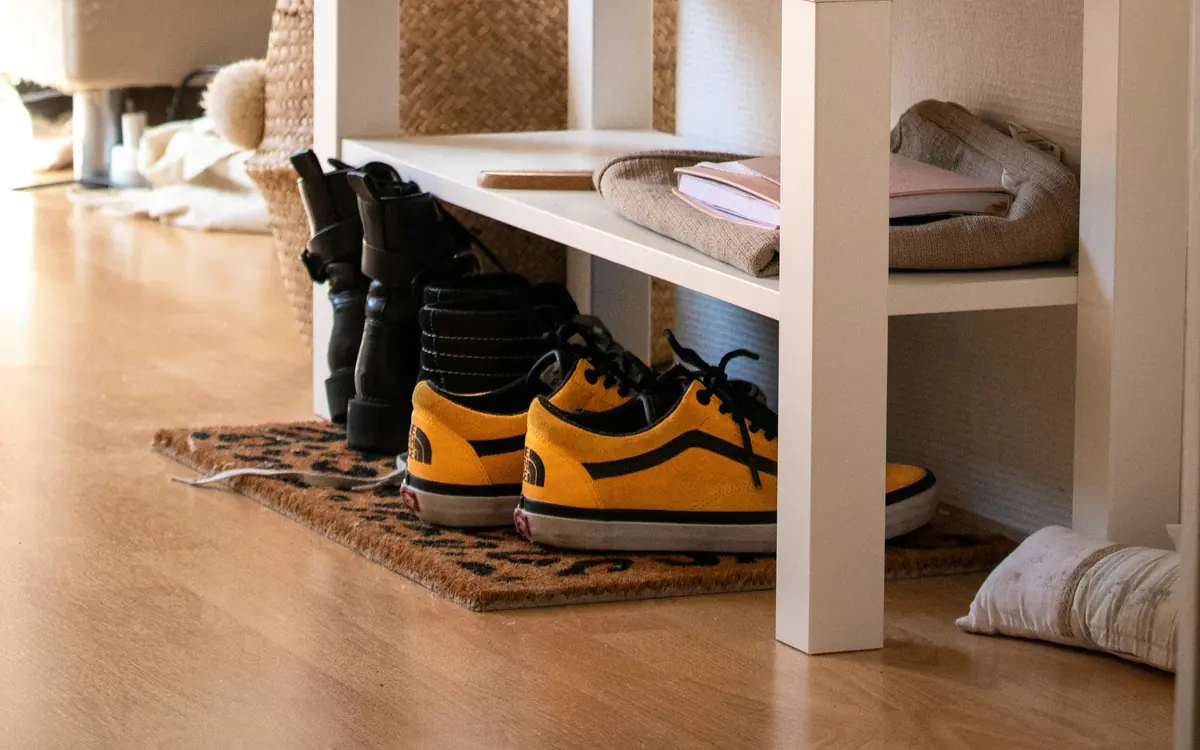
The best shoe storage is decided by two numbers rather than by the furniture: how many pairs you genuinely wear in a normal week, and how long and tall your largest pair is. Keep that active rotation at the entrance on something shallow and ventilated, move everything else to a bedroom, a wardrobe or an under-bed store, and give wet or muddy footwear a tray and time to dry before it goes anywhere enclosed. Rack, tilt cabinet, bench, cupboard or box is then a choice of format, not a change of principle.
Count the pairs by frequency before you look at the space
Bring the household’s shoes into one place and sort them into five piles: daily, work, occasional or formal, sport, and seasonal. Count each pile. Almost every hallway problem comes from asking the entrance to hold all five when it only needs the first two.
For most households the active rotation is a handful of pairs per person; the rest is touched weekly or monthly, so it can live anywhere convenient. A family of four might need eight to ten pairs at the door and have several times that number in the house. Let the first figure decide the capacity at the entrance, and the second figure decide where the archive goes.
A rack sized for the whole collection turns a hallway into a shoe shop; a rack sized for the rotation keeps the route clear and stays tidy on its own.
Measure the largest pair, not an average
Shoe furniture is sold in pairs, and the pairs the manufacturer had in mind are usually flat and small. Boots and trainers are what break the numbers. Measure the longest shoe in the house from toe to heel, the tallest boot from sole to top, and the bulkiest trainer across the sole.
Three decisions follow. The depth a shelf needs, which for adult shoes placed straight on is roughly the length of the longest pair. The height of at least one compartment, so ankle and knee boots do not have to lie on their sides. And the realistic capacity, which for adult footwear is normally lower than the figure on the label.
If a tilt cabinet is on the shortlist, check it against your own shoes: the tilt mechanism is what keeps the cabinet shallow, and it is also what refuses a thick-soled trainer.
Compare the formats before choosing one
| Format | Typical depth | Capacity | Ventilation | Best for |
|---|---|---|---|---|
| Open rack | Around 30 cm | Modest and honest | Very good | Daily rotation and drying |
| Tilt shoe cabinet | Around 17 to 25 cm | High for flat shoes | Moderate | Narrow hallways, dry everyday pairs |
| Bench with cubbies | Around 30 to 35 cm | Low | Good if the front is open | Somewhere to sit while putting shoes on |
| Closed cupboard | 35 cm and over | High | Poor unless vented | A calm look, clean and dry footwear |
| Over-door pockets | Around 12 to 15 cm | High for light shoes | Good | Children’s shoes, plimsolls, sandals |
| Under-bed boxes | Limited by bed height | Very high | Low, so contents must be dry | Off-season and occasional pairs |
| Wardrobe shelf | Around 35 to 40 cm | High | Moderate | Formal and occasional pairs |
| Under stairs low corner | Varies with the slope | High | Varies with the door | Family entrances with many pairs |
Most homes end up with two or three: something open at the door, something closed elsewhere, something flat under a bed. If the entrance also needs seating, read the guide to the storage bench before buying a rack, because one piece can do both jobs in the footprint of one.
What is the best way to store a lot of shoes?
Split the collection in two and treat the halves differently. The active rotation stays at the entrance, shallow and open. Everything else becomes an archive stored by category rather than by pair: boots together, formal together, sport together, seasonal together.
Give the archive a fixed home with a fixed limit, such as a wardrobe shelf, a run of stacked boxes or the low corner under the stairs. Label the face of each box that you actually see, not the lid, and if the boxes are opaque, photograph the contents and stick the photo or a written list to the front. The usual rules for storage boxes apply: rigid, lidded and sized to the shelf.
Then rotate on a date rather than on a feeling. Twice a year, when the weather turns, swap what is at the door with what is in the archive, and use the moment to notice the pairs that did not get worn in either half of the year. A large collection stays usable as long as the entrance stays small.
How do I store shoes when there is no space?
Use the spaces the home already has before you add furniture. Under the bed is the largest flat store in most bedrooms and takes shallow lidded boxes of clean, dry pairs. The back of a cupboard door takes a pocket organiser for light shoes. The bottom of the wardrobe takes a shelf or a two-tier rack instead of a heap, which is the first fix in any wardrobe organisation plan. The low corner of an under stairs cupboard is almost exactly shoe height.
Vertical space matters more than floor space here, and the same logic runs through the guide to storage ideas for small spaces: stack, hang or slide under, and keep the floor clear. If none of that is enough, the honest answer is that the collection is larger than the home can hold, and the fix is fewer pairs rather than more furniture.
Narrow hallways, the door swing and the way out
Before buying anything, mark the intended depth on the hallway floor with masking tape and live with it for a day.
Three checks decide whether the piece fits. The front door must still open fully over the mat. The walking route must stay wide enough to pass with shopping bags, a buggy or a suitcase. And nothing should sit loose on the floor of a hallway that is your escape route in a fire. Shallow tilt cabinets and wall-hung racks suit narrow halls precisely because they keep the floor clear, and the rest of the entrance, from coats to keys and post, is covered in hallway storage ideas.
Wet shoes, ventilation and smell
In the UK footwear arrives wet for a good part of the year, and enclosing a damp shoe is where both leather damage and smell begin. Put a tray or boot mat inside the door so wet pairs have a place to drip that is not the floorboards. Knock the mud off outside. Let shoes dry at room temperature and away from radiators or direct heat, which cracks leather and can distort soles, and stuff them loosely with newspaper so they keep their form while they dry.
A rack that smells is almost always damp plus poor airflow. Alternate pairs so each gets a full day to dry, take insoles out when shoes are soaked, wipe winter salt marks off before they set, and clean the rack itself. Move footwear into a closed cabinet or a sealed box only once it is completely dry.
Off-season pairs, children’s shoes and the ones that leave
Off-season pairs need four things: clean, dry, shaped and breathable. Clean off mud and salt, let them dry fully, use shoe trees or crumpled paper to hold the shape, and store them in a cotton bag or a box that admits some air rather than sealed plastic, which traps moisture against leather. Damp lofts and unheated garages are poor homes for shoes for the same reason.
Children’s shoes change faster than any other category. Keep the current size and perhaps the next one, put a low open basket at the door at the child’s height so they can manage their own pairs, and check fit regularly rather than storing outgrown shoes in the hope of a later use. Pass pairs on early, while another child can still get months out of them.
When pairs leave, clean them and keep each pair together by tying the laces or using a band. Charity shops accept wearable shoes; footwear that is beyond wearing usually belongs in a shoe bank or a textile recycling point rather than the bin, and the routes for both are set out in the guide to what to do with unwanted items.
A checklist before you buy anything
- How many pairs are in the active rotation, per person.
- The length of the longest shoe and the height of the tallest boot.
- The clear walking width left once the furniture is in place.
- Whether the front door still opens fully over the mat.
- Where damp footwear will drip and dry.
- Where the archive lives, and the date it gets rotated.
- Where the pairs that leave will actually go.
Answer those seven and the format almost chooses itself. The natural next step is the rest of the entrance: coats, bags, keys and post, in hallway storage ideas.
Frequently asked questions
Questions before you begin
What is the best way to store a lot of shoes?
Split the collection into an active rotation and an archive. Keep the pairs you wear each week at the entrance on shallow, open storage, and store the rest by category in labelled boxes or on a wardrobe shelf, swapping the two over twice a year. A large collection stays usable as long as the entrance stays small.
How do I store shoes when there is no space?
Use the spaces the home already has before adding furniture: shallow boxes under the bed, a two-tier rack in the bottom of the wardrobe, a pocket organiser on the back of a cupboard door, the low corner under the stairs, or a bench that stores shoes and gives you somewhere to sit. If none of that is enough, the collection is larger than the home can hold.
How deep does a shoe rack need to be?
Measure the longest shoe in the house, because that length sets the depth. Adult footwear placed straight on a shelf usually needs around 30 cm, while tilt cabinets are shallower, often around 17 to 25 cm, because the shoes sit at an angle and thick-soled trainers may not fit.
Should shoes be stored in boxes?
Boxes suit clean, dry pairs worn occasionally or seasonally, and they keep dust off. They are the wrong home for everyday or damp footwear, which needs airflow and one-movement access. Label the front of every box, or add a photo of the contents, or the pairs inside are quietly forgotten.
How do I stop a shoe rack smelling?
Smell is usually damp combined with poor airflow. Dry footwear fully before it goes back, alternate pairs so each gets a day to air, take insoles out when shoes are soaked, and use open storage rather than a sealed cabinet for daily pairs. Clean the rack itself too, because it collects mud and grit.
Where should wet shoes go?
On a tray or boot mat inside the door where they can drip and air, not straight into a closed cabinet or a sealed box. Knock the mud off outside, dry them at room temperature away from radiators and direct heat, and use newspaper or shapers so they keep their form while they dry.


