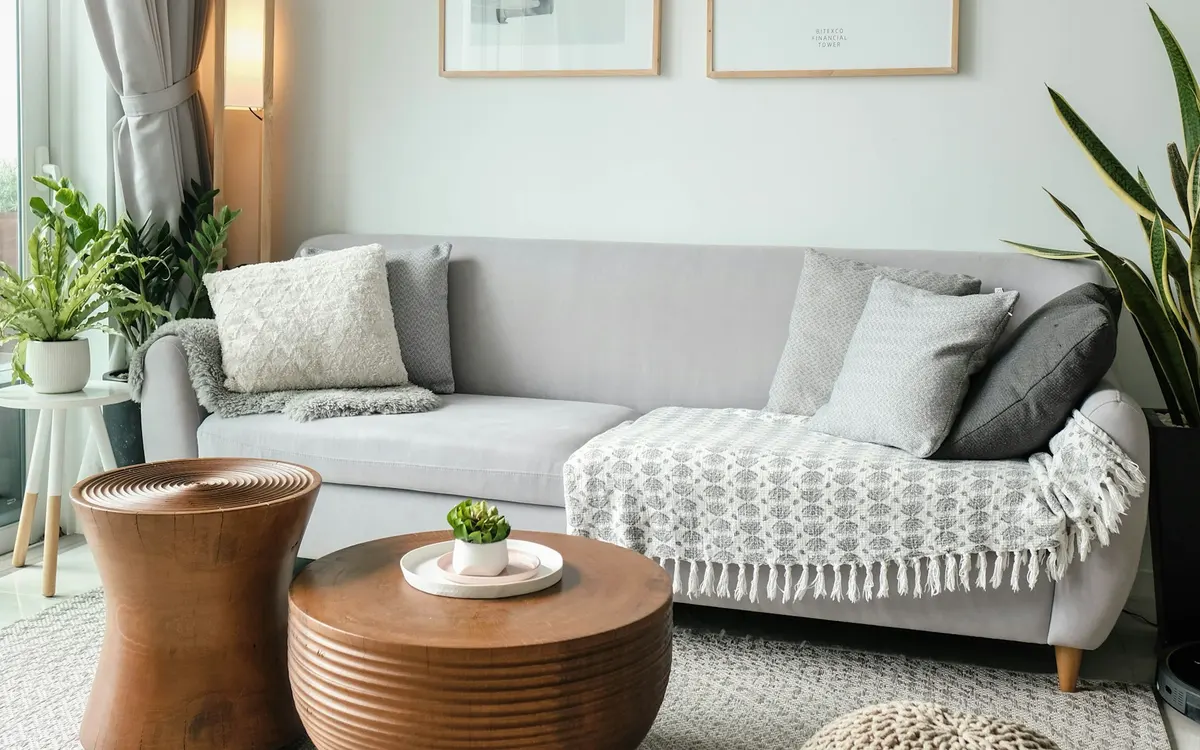
Minimalism is the deliberate practice of owning and doing less, so that whatever remains gets more of your space, money and attention. The word was first a label for an art movement and was only later borrowed for a way of living, which is why the same term now describes both a white-walled interior and a rule about what you buy. A minimalist home is the second thing rather than the first: a home whose contents fit its space and its household, whatever it happens to look like.
Where the word actually comes from
Minimalism began as an art movement, not a lifestyle. Tate defines it as an extreme form of abstract art developed in the USA in the 1960s, typified by works built from simple geometric shapes based on the square and the rectangle, with roots in the late 1950s and a run through the 1960s and 1970s. Frank Stella, Carl Andre, Dan Flavin, Donald Judd, Sol LeWitt, Agnes Martin and Robert Morris are the names usually attached to it, and Stella's summary of the whole idea — "what you see is what you see" — is about a work being nothing but itself.
That matters here for one reason: the original minimalism was an argument about representation, not about possessions. Nobody in that movement was telling anyone to own fewer mugs. Architecture and product design borrowed the visual language, magazines borrowed it from design, and the word arrived in the home as a description of a look.
The household sense of minimalism is a separate, later and much looser use of the same word, and it means something closer to voluntarily reducing what you own. Neither definition owns the other. Almost every bad piece of minimalism advice comes from quietly swapping one for the other — selling you a look while promising you a life.
The aesthetic and the practice are not the same thing
Once you separate them, most of the confusion disappears.
| Aspect | Aesthetic minimalism | Practical minimalism |
|---|---|---|
| What it changes | How a room looks | How much you own and buy |
| Measured by | Visible surfaces, palette, symmetry | Volume against the space available |
| Typical cost | Often high; replacing works with matching ones | Usually negative; you buy less |
| Fails when | Overflow is hidden in cupboards | Reserves and real needs get cut |
| Suits | Anyone who likes the look | Any household that owns more than it can maintain |
A colourful, book-lined, plant-filled home can be minimalist in the second sense. A beige showroom with three objects on display and four crammed cupboards is not. If getting the room photographable requires ten minutes of hiding things, the house does not have fewer possessions; it has less visibility.
The four versions people actually mean
When someone says they want a minimalist home, they usually mean one of four different things. Naming yours saves months.
| Version | The question it asks | Where to start |
|---|---|---|
| Functional | Does this make a real activity easier? | Worktops, hallway, bedside |
| Financial | Am I buying and storing duplicates? | Subscriptions, food cupboard, clothes |
| Visual | Does this room carry too much information? | Open shelves and surfaces |
| Time-based | How much of my time does owning this cost? | Collections, gadgets, anything maintained |
You do not have to pick one identity and hold it. A stripped-back kitchen, a visually calm living room and a very large record collection are perfectly consistent, provided each one is a decision rather than an accident.
Digital minimalism
Digital minimalism applies the same filter to attention rather than to floor space, and it is the version most people now need more than the physical one. Notifications, feeds, subscriptions and forty thousand near-identical photographs cost something real, and unlike a cluttered drawer they follow you into every room.
As a named idea it is most closely associated with the computer scientist Cal Newport, whose book Digital Minimalism: Choosing a Focused Life in a Noisy World is described by its publisher as a practical philosophy for a mindful, intentional use of technology that maximises its benefits while minimising its drain on attention, focus and time, built around a thirty-day period away from optional technologies.
The philosophical part is worth taking seriously, because it is what separates digital minimalism from a detox. A detox asks what you can survive without for a month. Digital minimalism asks a harder question: what was that app doing for you, and what will do that job better? Deleting a social app without replacing the connection it carried tends to last about eleven days. Deciding that you will speak to three people by voice each week, and that the app is no longer how you do it, tends to last.
Three principles carry most of the benefit. Optional is the default: a technology earns a place by serving something you already value, not by being mildly useful. Attention is the scarce resource, not storage. And the setting beats the intention — a phone that does not buzz needs no willpower.
The practical sequence — verified backups first, then downloads, duplicates, unused apps and email noise — is in the guide to digital decluttering.
The honest criticisms
Minimalism deserves the objections made against it, and a guide that skips them is selling something.
It can become its own consumerism. Replacing perfectly good possessions with fewer, more expensive, better-looking ones is a purchase, not a reduction. Buying a set of matching storage, a capsule of new clothes and a new bed frame in order to own less is the most common way people spend money getting minimalist. The rule that protects you is simple: reduction should mostly cost nothing.
It suits some households and not others. A single person in a flat can run a very lean home. A household with young children, a hobby that needs equipment, a disabled member, a home business or a caring role cannot, and should not try. Large families, people on low incomes who cannot afford to re-buy something they discarded, and anyone who has known scarcity all have good reasons to keep more reserve than a minimalist blog would allow.
Bare is not the same as calm. Removing things past the point of usefulness produces a home that fights you: no spare bedding, no second pan, nowhere for a guest to put a coat. The target is that the amount owned fits the space and the household, not that it approaches zero.
It is not a solution to hoarding. Hoarding disorder is described by the NHS as a mental health condition in which someone collects so many things that it affects their life or the lives of the people they care about, with a strong attachment to the items and real difficulty getting rid of them. It is not a decluttering failure and it does not respond to buying rules or a thirty-day challenge; a forced clear-out can make things considerably worse. That is a different subject with a different method, and it is covered separately in the guide to hoarding disorder.
How to start without going extreme
- Pick one visible benefit. A table you can eat at, a wardrobe you can dress from in two minutes, a bedside with only what you need. Abstract goals do not survive a busy week.
- Pause intake for thirty days in the one category that overflows — clothes, books, kitchen gadgets, toys. Nothing new comes in; you simply observe how often you reach for the pause.
- Remove the obvious first: duplicates, broken items with no repair plan, and things kept for a version of you that no longer exists. The method and the exits are in the decluttering guide.
- Set a physical limit rather than a number — one shelf, one drawer, one rail, one box. Physical limits enforce themselves; counts do not.
- Look upstream at the purchase that created the excess, not just at the object. The same decision will otherwise refill the shelf within a year.
If deciding is the hard part rather than doing, decluttering rules explained compares the shortcuts people use, and the Marie Kondo method is the best known of them.
Room by room, without redecorating
The bedroom is the easiest room to make minimalist because its purpose is narrow: sleep, dress, recover. Keep the route to the bed clear, give clothes worn once and not yet washed one limited place instead of a chair, and reduce the bedside to light, water and one book. Off-season clothes belong outside the wardrobe, in labelled breathable bags or vacuum storage bags; a bed with storage or an ottoman can take bedding if the lift is easy enough that you will actually use it. The full method is in bedroom organisation.
In the living room, name the activities that genuinely happen — reading, television, play, hosting — and tie storage to those. Anything left is décor competing for attention, which is fine as long as it is chosen. In the kitchen, limit what stays on the worktop and keep the utensils you cook with rather than the ones you own. Both rooms want closed storage for visually noisy categories and a small amount of open display for things you enjoy seeing.
Clothes are where the excess usually lives, and they are also the category with the clearest method: wardrobe organisation for the space itself, and the capsule wardrobe guide if you want a smaller coordinated set.
Buying rules that keep it minimalist
- A waiting list instead of a basket, reviewed after a week.
- A named home for the item before it is bought, not afterwards.
- Replace, do not add: the new coat means the old one leaves.
- Prefer repairable, versatile and correctly sized over "minimalist-looking".
- Ask what the thing will cost to store, clean, insure and eventually get rid of.
Families, sharing and rented homes
A shared home needs shared limits, not one person's aesthetic imposed on everyone else. Agree limits by category rather than by person — toys, mugs, shoes by the door — and give each member of the household a private zone that runs by their own rules and is not negotiated. Children can hold a limit they helped set and will fight one imposed on them.
In rented homes, favour reversible systems and furniture that earns its floor space over anything fitted, and check the tenancy agreement before drilling. Furniture you can take with you is worth more than built-in storage you will leave behind.
What to keep without guilt
Keep the tools for real responsibilities, proportionate reserves of the things you use, accessibility and medical equipment, seasonal kit, and the objects that give you genuine pleasure. Never dispose of other people's belongings, legal documents, warranties or safety items to fit an image of a home.
Quick checklist
- One visible benefit chosen, in one room.
- A thirty-day intake pause on the category that overflows.
- Duplicates and broken items removed first.
- A physical limit set for what stays, not a target number.
- One buying rule written down where you will see it.
- Nothing bought in order to own less.
If the excess is mostly on screens, continue with digital decluttering. If the problem is that the house drifts back within a fortnight, the habits that hold it are in keeping the house tidy.
Sources and references
Frequently asked questions
Questions before you begin
What is minimalism?
As a way of living, minimalism means deliberately owning and doing less so that what remains gets more of your space, money and attention. As an art term it means something else entirely: Tate defines it as an extreme form of abstract art developed in the USA in the 1960s, built from simple geometric shapes. The household use borrowed the name much later and is a separate, looser idea.
What is the meaning of minimalism in a home?
A minimalist home is one whose contents fit its space and its household, and which the people living there can maintain without effort. It is not defined by white walls, a colour palette or a target number of possessions. A colourful, book-filled house can be minimalist; a bare showroom with four crammed cupboards is not.
Is minimalism just an aesthetic?
The aesthetic and the practice are two different things and they often get sold as one. Aesthetic minimalism changes how a room looks and can cost a great deal; practical minimalism changes how much you own and usually costs nothing. If getting the room photographable means hiding piles first, only the aesthetic has changed.
What is digital minimalism?
Digital minimalism applies the same filter to attention rather than to floor space. As a named idea it is most closely associated with Cal Newport, whose book Digital Minimalism is described by its publisher as a practical philosophy for intentional technology use that maximises the benefits while minimising the drain on attention, focus and time. In practice it means deciding what each app was for and what will do that job better.
Do I need a nearly empty home to be a minimalist?
No, and removing things past the point of usefulness produces a home that fights you. Keep the tools for real responsibilities, proportionate reserves, accessibility equipment, seasonal kit and the things that give genuine pleasure. The target is that what you own fits the space and the household, not that it approaches zero.
What are the criticisms of minimalism?
The strongest one is that it can become its own kind of consumerism: replacing good possessions with fewer, more expensive ones is a purchase, not a reduction. It also suits some households far more than others, and people on low incomes who cannot afford to re-buy something have good reason to keep more reserve. Reduction should mostly cost nothing.
Can a family practise minimalism?
Yes, but with shared limits rather than one person’s aesthetic imposed on everyone. Agree limits by category — toys, mugs, shoes by the door — and give each person a private zone that runs by their own rules. Children hold a limit they helped set and resist one imposed on them.
Does minimalism help with hoarding?
No. The NHS describes hoarding disorder as a mental health condition in which someone collects so many things that it affects their life or the lives of people they care about, with strong attachment to the items and real difficulty discarding them. It does not respond to buying rules or thirty-day challenges, and a forced clear-out can make things worse.


