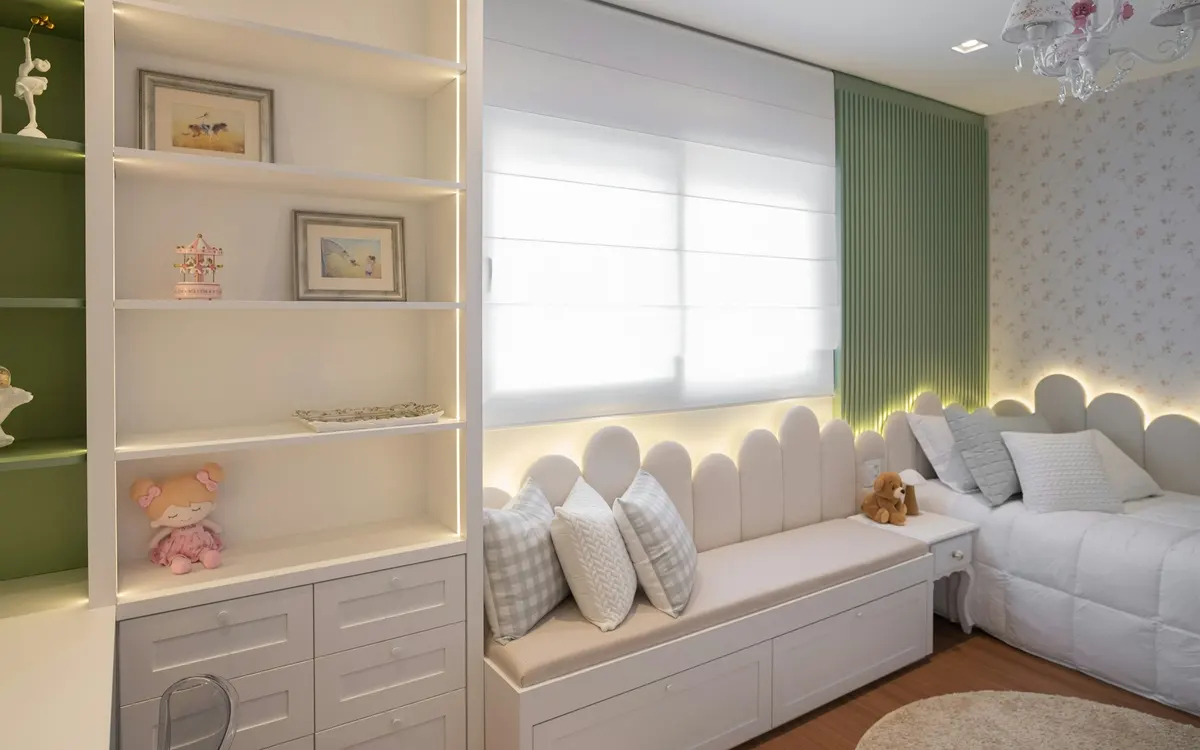
Toy storage works when a child can use it without an adult in the room: a small number of broad categories they recognise, containers low enough and light enough to lift, and labels that show a picture as well as a word. Sort by how a toy is played with rather than by what it is, keep part of the collection away and rotate it, and give sets with many small pieces a lidded box of their own. Anchor tall or top-heavy units to the wall, and prefer open baskets to heavy lids where young children are the ones opening them.
Sort by play type, not by object
Adults sort by object: cars here, animals there, wooden things together. Children look for the thing they want to do. The categories that survive are the ones a four-year-old can name without translation: building, drawing and making, small world figures and animals, vehicles, games and puzzles, books, dressing up, outdoor things.
Keep the number small: six to eight categories in a bedroom is plenty, and fewer works for younger children. A category so specific that only the adult knows where an item belongs will not be maintained, because putting things away becomes a quiz with a right answer.
Hand the child three random toys and ask where each one goes. If they hesitate on more than one, the categories are too fine or the labels are wrong.
Keep an active selection and rotate the rest
Having everything out at once makes both play and tidying worse. The floor fills with things nobody chose, and the reset at the end is too big for a child to finish, which is how tidying becomes an argument. An active selection, chosen across categories rather than by emptying one, leaves room to play and keeps the reset short enough to complete.
Store the rest in labelled boxes on a high shelf or in a wardrobe, out of sight rather than out of reach. Swap part of the selection every few weeks, or whenever interest visibly drops. Toys that come back after a month are often played with as though they were new, which is the practical case for rotation: it costs nothing and buys attention.
Rotation is also the gentlest way to see what is genuinely unused. When a box comes back untouched twice it has told you something, and the guide to decluttering covers what to do next.
Low, open and light, at the child’s height
Three properties decide whether a child can run the system alone.
- Low. Containers used daily sit at or below the child’s shoulder height. Upper shelves belong to the adult and hold the rotation stock.
- Open. Baskets, trays and open compartments let a toy go back in one movement. Half the value of cube storage with children is that some cubes stay open.
- Light. A full container should be liftable by the child who uses it. A single large box of wooden blocks becomes immovable, so split heavy categories into two smaller boxes rather than one big one.
Rigid boxes stack and keep their shape; fabric ones are kinder when they land on a foot. Match the container to the category rather than to the shelf, and check the same points as any other storage boxes decision: lid or no lid, stackable, readable from the front.
Label with a picture and a word together: photograph the contents, or draw the category, and put the word underneath in lower case so it does the job later when reading arrives. Put the label on the front face of the container and a matching one on the shelf edge, so the empty space still says what belongs there. Make the labels with the child, because a system they helped build is one they can explain to a grandparent or a babysitter.
What works at each age
| Age or stage | What works | What to avoid |
|---|---|---|
| Baby and early toddler | A few open baskets at floor level, with the selection controlled by an adult | Small parts within reach, heavy lids, anything climbable |
| Two to three | Four to six picture-labelled baskets, one low shelf, strong rotation | Deep toy chests where everything sinks to the bottom |
| Three to five | Six to eight categories, picture and word labels, low open shelving | Fine sorting by set, brand or colour |
| Five to seven | Word labels, a box per large set, a place for work in progress | Tipping several sets into one container |
| Seven and over | Categories the child defines, a drawer for small collections, a display shelf | Reorganising the room without them |
Toys that live in the living room and hallway
Toys migrate to wherever the adults are, and fighting that costs more energy than containing it. Give the living room a named, limited home: one or two baskets or a low unit holding a subset that changes with the rotation. When those containers are full, the surplus goes back to the bedroom rather than onto the floor. That limit does more than any rule about tidiness, and it fits the wider approach in living room storage ideas.
The hallway usually holds the outdoor edge of the collection: a scooter, a ball, wellies, a bag for nursery. Keep it off the floor and out of the route to the front door.
Big sets, small pieces and sharing between siblings
Sets with hundreds of pieces need a box of their own: deep enough to sweep pieces into, shallow enough for a child to see the bottom, and clearly the home of that set alone. Keep the instructions in a labelled folder or a clear pocket inside the same box, because a set without its instructions quietly becomes loose pieces. A part-built model also needs somewhere to sit unfinished, such as a tray or a shelf.
With siblings, separate personal from shared. Shared categories such as building, games and art materials live in shared containers in a shared place. Personal things, including the current favourite, a collection or anything a child does not want handled, get a named box or drawer that nobody else opens, which is easier to arrange once the room itself is planned as in bedroom organisation. Most sibling arguments about toys are boundary problems rather than tidying problems.
Safety: anchoring, lids and small parts
RoSPA’s guidance on preventing accidents to children states that furniture and tall kitchen appliances at risk of being pulled over should be secured to the wall, and points out that a set of drawers looks like an ideal climbing frame to a child. Toy shelving is exactly that: anchor tall or top-heavy units, keep the heaviest boxes on the bottom shelf, and never make the top shelf the interesting one.
The same guidance advises keeping small objects such as marbles, peanuts and small toys out of reach of children under three, and choosing toys appropriate to the age of the child. In a mixed-age household that is the practical reason to keep small-part sets on a high shelf and bring them down for play at a table, rather than storing them in the shared low baskets a toddler can reach.
Two further ordinary cautions. A heavy hinged lid can trap fingers or fall on a child leaning into the box, so open baskets, a lid that lifts off entirely, or one with slow-fall support are safer choices for storage a young child opens alone. And keep boxes off the floor of the route between the bedroom and the front door, so nobody trips in the dark or in a hurry.
A tidy-up a child can actually finish
- One category at a time, named aloud: all the books first, then the vehicles.
- The same cue every day, such as before the bath, before tea or before a story.
- Every container already open and within reach before you start.
- A short, fixed time, with the adult doing the parts the child cannot.
- The floor cleared first, before anything on the shelves is perfected.
- A last look at the labels, so the gaps show what is still missing.
If the reset regularly cannot be finished, the problem is nearly always volume rather than willingness. Reduce the active selection before changing the routine.
Broken, incomplete and outgrown toys
Review the collection every few months, with the child where realistic, and not during a play session. There are four outcomes: repair, with a date attached; keep; pass on; recycle.
Incomplete puzzles and games deserve one grace period: keep a single missing-pieces box for a month, and if the pieces have not turned up, let the set go. Toys in good condition should move on quickly, while they still have value to another family: charity shops, local groups or friends. Electrical and battery-powered toys have their own recycling route, and batteries must never go in the household bin, which is covered in the guide to unwanted items.
When the storage is right, a child can find, use and return most of their own things without help, and the adult effort drops to the rotation and the quarterly review. The next step is the rest of the room, from clothes to the bed and the surfaces around it, in bedroom organisation.
Sources and references
Frequently asked questions
Questions before you begin
How do I organise toys so my child will tidy up?
Use a few broad categories the child can name, low open containers they can lift when full, and labels with a picture and a word on the front. Then keep the tidy-up short enough to finish and tie it to the same daily cue. If it still cannot be finished, there is too much out rather than too little willingness.
What is toy rotation and does it work?
Rotation means keeping part of the collection available and the rest stored out of sight, then swapping some of it every few weeks. It works for two practical reasons: a smaller selection leaves room to play and makes the reset short enough for a child to complete, and toys that return after a break often get fresh attention.
How many toys should be out at once?
There is no fixed number, but there is a working test: the child should be able to reset the room in a few minutes with a little help and still find what they want. If the floor fills with things nobody chose, or the tidy-up never gets finished, reduce the selection across all categories rather than removing one category entirely.
Do toy boxes need to be anchored?
Low boxes and baskets do not, but anything tall, top-heavy or climbable does. RoSPA advises that furniture at risk of being pulled over should be secured to the wall, and notes that drawers look like a climbing frame to a child. Shelving with half-open boxes is exactly that, so anchor it and keep the heaviest items on the bottom shelf.
How do I store toys in a living room?
Give them a named, limited home rather than trying to keep them out: one or two baskets or a low unit holding a subset that changes with the rotation. When those containers are full, the surplus goes back to the bedroom. Containing the migration works better than banning it.
What should I do with outgrown toys?
Pass them on while they still have value to another family, through charity shops, local groups or friends. Set a date for anything awaiting repair, and let incomplete sets go after one grace period. Electrical and battery toys have their own recycling route, and batteries must never go in the household bin.


