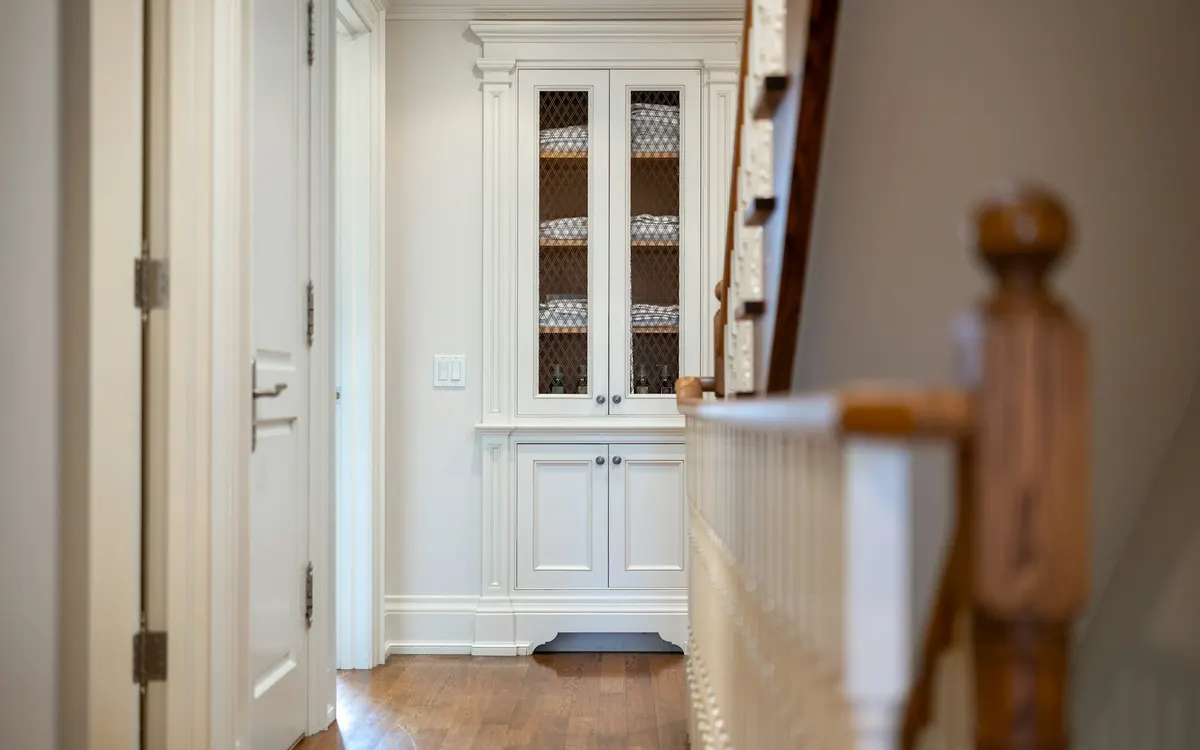
The best under stairs storage ideas follow the shape of the space rather than fighting it: the tall end takes coats, the hoover or a pull-out unit, the middle takes shelves and labelled boxes, and the low corner takes only shoes, baskets or a shallow drawer. Measure the height at three points, the depth and the door swing before you decide between organising the cupboard you already have, fitting pull-out drawers or opening the space into shelves. Whatever you choose, keep the consumer unit, meters and stopcock reachable and keep the hallway itself clear, because it is usually your escape route.
Measure the triangle before you buy anything
Under stairs storage fails for one boring reason: people buy for the tall end and discover that most of the cupboard is the low end. Stand at the door and record three heights, one at the highest point, one halfway along and one at the last point you can reach without crawling. Add the depth from the door to the back wall, the clear width of the door opening and the direction the door swings. If the cupboard has a sloping ceiling on one side as well as along its length, note that too.
Those five numbers decide almost everything. A pull-out unit needs a straight run of floor and a door that opens at least as wide as the drawer. Shelves need a back wall at a usable height. A shoe zone only needs the low corner, which is why it is often the easiest win in a narrow hallway. Photograph the inside with a tape measure in shot so you can check any product against the real space later, and treat the numbers as the brief for everything in storage ideas for small spaces.
Option 1: organise the cupboard you already have
The least permanent option costs the least and suits renters. Empty the cupboard completely, then rebuild it in height order. At the tall end fit a row of hooks or a short rail for coats, and park the hoover and ironing board against the wall where they can be lifted straight out. In the middle, add freestanding or wall-fixed shelves sized to the boxes you actually own rather than the other way round. In the low corner, use two or three shallow baskets or a low drawer unit that slides forward with one hand.
Label every box on the side that faces the door, not the lid, and give each category a physical limit: one box of light bulbs and batteries, one basket of dog kit, one crate of picnic things. When a category outgrows its container, edit the category rather than adding a second container. A plug-in or battery light on the ceiling turns the cupboard from a black hole into a usable space in five minutes. The same rules for storage boxes apply here as anywhere else: rigid, lidded, sized to the shelf.
Option 2: pull-out drawers and units
Pull-outs solve the deep-triangle problem by bringing the back of the cupboard to you. A bespoke fitted unit is made to the exact slope, so every centimetre works, and it is the option that adds most to the look of a hallway. It is also the most expensive and the most permanent, so it suits owners who intend to stay. Modular pull-out units sit in the middle: standard cabinets on runners that a joiner or a confident DIYer fits inside the existing opening, with panels to close the awkward gaps.
Whichever you choose, ask three questions. Does the deepest drawer still open fully with the hallway furniture in place? Can the runners carry the load you intend, such as a drawer of shoes or a drawer of tins? And can you still reach the consumer unit, meters and stopcock without pulling everything out? If the answer to the last question is no, redesign before you order.
Option 3: open shelving or a reading nook
Removing the door and turning the triangle into open shelving or a small desk works in hallways wide enough to keep the walking route clear. Open shelves show everything, so this option only suits categories that look calm on display: books, a few baskets, a coat rail with a small bench. It is also the version that most often disappoints, because the low corner cannot hold a bookshelf and ends up as a gap.
A nook with a small desk or a bench suits a home office or a place to put on shoes, but check headroom at the point where you sit and whether a light can be fitted. If the hallway is narrow, keep the door and choose one of the first two options instead.
| Option | Permanence | Best for | Watch out |
|---|---|---|---|
| Organise the existing cupboard | Low, fully reversible | Renters, tight budgets, quick wins | Boxes bought before measuring; no light inside |
| Modular pull-out units | Medium | Deep cupboards, owners on a budget | Door width, runner load, access to meters |
| Bespoke fitted drawers | High | Long-term homes, hallway appearance | Cost, lead time, reach to stopcock and consumer unit |
| Open shelving or nook | Medium to high | Wide hallways, display categories | Route width, low corner wasted, visual clutter |
| Shoe and coat combination | Low to medium | Family entrances with wet footwear | Ventilation, escape route, damp behind boxes |
Shoes, coats and the hallway connection
Under stairs shoe storage is the most searched version of this question for a reason: the low corner is exactly shoe height. A shallow rack or a row of open cubbies along the low wall keeps daily pairs off the hallway floor, and the tall end takes coats so the entrance stops collecting layers. Keep only the active rotation here and move the rest of the collection to the bedroom or a closed cabinet, following the same logic as the guide to shoe storage ideas.
If the hallway allows it, a bench beside the cupboard door gives a place to sit and a second layer of shoe storage without touching the cupboard. The guide to choosing a storage bench covers seat height and ventilation. Whatever you add, the walking route and the door swing must stay as they were, because a hallway that narrows is a hallway that fills up.
Parking for the hoover, pram or freezer
Large single items suit the tall end best because they come out in one move. A hoover needs a hook for the hose and a socket nearby if it charges. A pram or folded buggy needs the door width and a dry floor. A small freezer is possible in a large cupboard, but only if it fits with the ventilation clearances given in its manual, a socket sits within reach without an extension lead, and the cupboard does not get warm or damp. A closed cupboard with no airflow makes the appliance work harder, so read the manual before treating it as a utility corner.
A bike is the item that most often ends up here by default. It can work in a tall, straight cupboard with a floor stand, but a bike in the hallway itself is a problem in a house and a hazard in a flat. The guide to bike storage ideas goes through the alternatives.
What must stay accessible and safe
Most homes keep the consumer unit, electricity or gas meters and the internal stopcock somewhere under or beside the stairs. Leave a clear path to each so you can switch off power or water in seconds, and never stack boxes against a meter cupboard. Do not store petrol, gas cylinders, solvents or other fuels here, and do not charge e-bike or e-scooter batteries in the cupboard or the hallway. London Fire Brigade advises storing and charging them away from a main through-route or exit and never blocking an escape route with them.
The hallway itself is the route you would use in a fire. The Home Office Fire Kills leaflet asks households to plan an escape route, keep exits clear and keep door and window keys where everyone can find them. In flats, London Fire Brigade states that communal corridors and staircases must be kept free from clutter, including pushchairs and e-bikes. Keeping the cupboard door closed at night also slows the spread of fire and smoke, which is one more reason to keep the door rather than remove it.
Renting? Keep it reversible
Tenants can still get most of the benefit. Freestanding shelving, stackable drawer units, a plug-in light, tension rails for coats and self-adhesive hooks sized for their load all leave no trace. Ask before drilling into the stair string or the wall, and keep any original shelf or rail you remove so the cupboard can be returned as found. The organising logic in the guide to hallway storage ideas works the same way whether you own or rent.
Quick checklist
- Height measured at three points, plus depth, door width and swing
- Consumer unit, meters and stopcock reachable without moving anything
- Tall end for coats, hoover or pull-out; middle for shelves; low corner for shoes
- Every box labelled on the side facing the door
- A light inside the cupboard
- Nothing stored in the hallway itself, no fuels, no battery charging
- Door kept and closable
Once the triangle is working, the next decision is usually the seat beside it. Continue with the guide to choosing a storage bench for the hallway.
Sources and references
Frequently asked questions
Questions before you begin
What can I store under the stairs?
Coats, shoes, the hoover, cleaning kit, a pram or folded buggy, seasonal items in labelled boxes, and in larger spaces a small freezer or a home office nook. Keep the consumer unit, meters and stopcock reachable and avoid storing fuels or charging e-bike batteries there.
How do I organise an under stairs cupboard?
Empty it, measure the height at three points, then zone by height: tall items and hooks at the high end, shelves and labelled boxes in the middle, shoes or baskets in the low corner. Add a light and keep a clear path to anything you use weekly.
Is it safe to store things under the stairs?
Yes, provided the hallway that forms your escape route stays clear, the cupboard door closes, and you do not store fuels, gas cylinders or charge lithium batteries there. UK fire safety guidance asks households to plan an escape route and keep exits clear.
Can a fridge or freezer go under the stairs?
Often yes if the appliance fits with the ventilation clearances given in its manual, a socket is within reach without an extension lead, and the cupboard does not get too warm or damp. A closed cupboard with no airflow can make the appliance work harder, so check the manual first.
How much does under stairs storage cost?
It depends on permanence. Organising the existing cupboard with hooks, shelves and boxes costs least, modular pull-out units sit in the middle, and a bespoke fitted unit with drawers is the most expensive because it is made to the exact triangle. Get more than one quote for fitted work.


