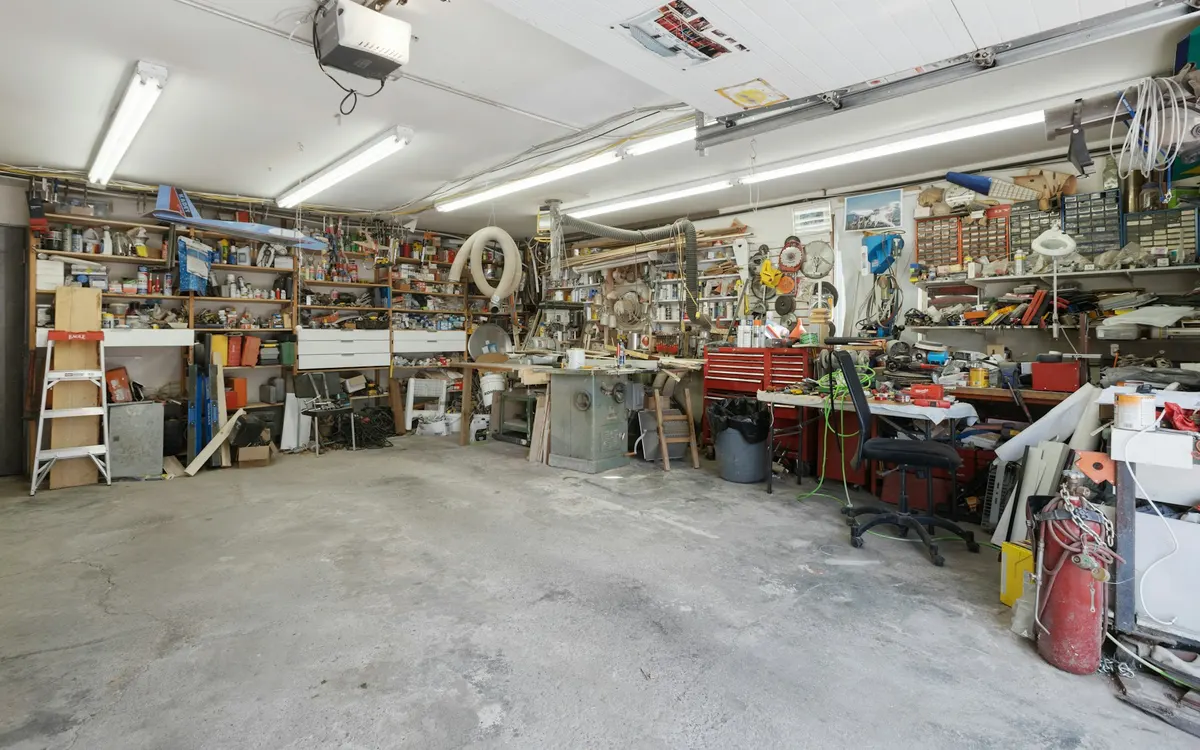
Good garage storage starts with a decision about the building, not about shelving. A typical British garage is a single-skin, unheated box that swings from near-freezing to warm across the year, so it suits metal, plastic, timber, tools and garden kit, and ruins paper, textiles and electronics. Decide what genuinely belongs there, follow the legal rules for petrol and the fire service advice for gas and aerosols, then organise what remains into four zones: wall, overhead, floor and workbench.
Start with the building, not the shelving
Walk into most UK garages and you are standing in something closer to a shed than a room: one leaf of brick or block, no cavity, no insulation, no heating, an up-and-over door with a gap beneath it, and a concrete floor laid on the ground. Air moves through it whenever the door opens, cold surfaces attract condensation on winter mornings, and the temperature follows the weather rather than a thermostat.
That building decides the contents. It suits anything that rust, cold and damp cannot destroy, and is a poor home for anything absorbent or with paper or electronics inside it. The expensive garage mistake is rarely the wrong shelf; it is the box of photographs or the spare mattress put out there to be dealt with later, quietly spoiling over two winters.
If a car still lives in it, park it inside, open both front doors fully and mark the floor with tape at the widest point. Everything you build sits outside those lines, and the strip where people walk is the space storage keeps stealing.
What belongs in a garage, and what does not
| Item | Store here? | Why |
|---|---|---|
| Garden tools, mower, hose | Yes | Built for outdoor conditions; hang metal rather than stand it on concrete |
| Hand and power tools | Yes, if kept dry | Closed cabinets or lidded boxes protect bare steel from condensation |
| Bikes, scooters, sports kit | Yes | Get them off the walking route |
| Paint, fillers, adhesives, sealants | Check each label | Many state a storage temperature range; keep upright, sealed and in the original tin |
| Petrol and two-stroke fuel | Only within the legal limits | Container sizes and quantities are set out below |
| LPG and camping gas cylinders | No | Fire services advise storing cylinders outside |
| Aerosols in quantity | No | Fire services advise against keeping them indefinitely in sheds and garages |
| Paperwork, photographs, books | No | Damp, silverfish and mice find them |
| Electronics, appliances, battery tools | No | Cold and condensation; batteries dislike both |
| Mattresses, upholstery, textiles | No | Absorbent and attractive to pests |
Anything that fails this test needs somewhere else to go: sometimes the loft, with its own limits in loft storage ideas, more often out of the house through what to do with unwanted items. Reducing the volume before you build is the step people skip, and the sequence is in the guide to decluttering.
Petrol, gas and aerosols: the rules that set your layout
These are the only garage decisions with legal weight behind them, so make them before you plan a shelf. The Health and Safety Executive states that you can store up to 30 litres of petrol at home or at non-workplace premises without informing your local Petroleum Enforcement Authority. That total must sit in suitable portable containers: plastic containers of up to 10 litres, metal containers of up to 20 litres, or one demountable fuel tank of up to 30 litres. Petrol must not be stored in living accommodation, and where it is kept indoors there must be a direct exit to the open air and ventilation to that exit.
Fire and rescue services add practical advice. Hampshire and Isle of Wight Fire and Rescue advises decanting fuel in the open air rather than inside a garage or shed, and storing gas cylinders for gas heaters outside, away from direct sunlight and frost. Cambridgeshire Fire and Rescue advises against storing quantities of aerosols indefinitely in sheds and garages or under-sink cupboards, and says to protect them from sunlight and not expose them to high temperatures.
So fuel and gas belong at the far end from that door, low down, with no socket above them — and a can of spray paint that has spent three summers on a sunny shelf is a disposal problem, not an organisation one.
Zone 1: the walls
The wall is the most valuable surface in a garage because it adds capacity without taking floor. Long-handled tools, ladders, hoses, folding chairs and buckets should hang rather than lean, because anything leaning eventually falls across the route.
Work in three bands. Below knee height, bulky stable items you slide rather than lift. Between hip and shoulder, everything used weekly. Above shoulder height, only light items you can lower with one hand. A full toolbox on a high shelf is a hospital visit waiting for a bad day.
Fixings decide whether any of it holds. A garage wall may be solid masonry, blockwork that crumbles around a plug, or plasterboard on studs in an integral garage. That question, and the choice between bracketed shelving, rail systems and freestanding racking, is covered in shelving ideas rather than repeated here. One rule is worth stating twice: tall racking and cabinets must be anchored so they cannot be pulled over.
Zone 2: overhead
Overhead is for things you touch once or twice a year — camping gear, roof bars, the Christmas box. Not for anything heavy, anything needed in a hurry, or anything you cannot bring down with both hands free.
Three checks first. The garage door mechanism needs clear travel, and the track and springs must never be obstructed. The structure may be a lightweight truss, a felt deck or a cement sheet, none of which is automatically a load-bearing ceiling, so follow the fixing instructions or take advice. And if retrieval needs a stepladder fetched from elsewhere, the shelf will fill and never empty.
Store it in labelled rigid boxes, with the label on the end that faces you; which box survives a cold, damp building is covered in storage boxes.
Zone 3: the floor
The floor is where garage systems fail, because it accepts things without a decision being made. Anything put down "for now" is still there next year.
Give it three jobs and no others: a clear walking route wide enough to carry a bag of compost through; marked bays for large stable objects that genuinely stand on the ground, such as the mower, the bins and the freezer; and nothing else at all.
Keep cardboard off the concrete entirely, using rigid boxes on a bottom shelf, a pallet or a low plinth, so the floor can be swept and any leak stays visible. Bikes are the biggest single floor problem in most garages, and the hooks, stands and racks are compared in bike storage ideas.
Zone 4: the workbench
A workbench is not a shelf you happen to stand at. It needs a solid top at roughly waist height, enough depth to take a project without pushing it off the back edge, a light you can see the work under, and a wall behind it holding the tools.
The rule that keeps it usable is that the surface is a working area, never storage. Give every tool a marked home on the wall or in a shallow divided drawer, because a tool with no obvious place ends up on the bench; the principles are the same as in drawer organisers. Keep a bin, a brush and a first aid kit within reach.
Damp, cold, rust and pests
Condensation forms on the coldest surface, usually the external wall and the metal door. Leave a gap between shelving and an external wall so air can move, keep air bricks and vents clear, and never seal anything damp into a plastic box, because a sealed box cannot let moisture out. Bare steel rusts faster here than people expect, so keep tools in a closed cabinet and wipe them dry.
Mice and insects come in for food, warmth and nesting material, so keep no birdseed, pet food or grass seed in open bags, no cardboard and no loose fabric. If a mouse would ruin it, it does not live in the garage.
Chemicals, children and locking up
Garages hold the most dangerous products in a household: weedkiller, slug pellets, white spirit, wood preserver, brake cleaner. RoSPA's guidance on preventing accidents to children is direct about these. Keep medicines and chemicals out of sight and reach of children, preferably in a locked cupboard, and always store chemicals in their original containers.
In practice: one lockable cabinet, mounted high, holding every garden and DIY chemical in its own labelled tin with the cap closed, never decanted into a drinks bottle. The same guidance says furniture and tall appliances at risk of being pulled over should be secured to the wall, which in a garage means the racking and the tall cabinet.
A seasonal reset that takes one hour
- Walk the route with a full bag in each hand and remove whatever you had to step over.
- Check under and behind everything for damp, droppings or a leaking container.
- Open every unlabelled box, decide, and label the end that faces you.
- Check fuels, aerosols, paints and garden chemicals, and dispose of failures through your council's hazardous waste route.
- Confirm the fuel total is within the legal limit and the chemical cabinet is locked.
- Confirm racking and tall cabinets are anchored and nothing is leaning on a wall.
Once the zones hold, the remaining questions are what the shelves are fixed to and what sits on them: shelving ideas for the load and the wall, storage boxes for containers that survive a cold, damp building.
Sources and references
Frequently asked questions
Questions before you begin
How do I organise a garage on a budget?
Remove what does not belong in an unheated, damp building first, because that alone usually frees a third of the space. Then hang long-handled tools and bikes on the walls, keep the floor to a clear route plus a few marked bays, and buy containers last, once you know what is actually staying.
What should not be stored in a garage?
Paper, photographs, books, textiles, mattresses, upholstered furniture, electronics and anything with a battery, because a single-skin UK garage swings between cold and warm and collects condensation. Gas cylinders should be stored outside, and fire services advise against keeping quantities of aerosols indefinitely in sheds and garages.
How much petrol can I legally store at home?
The Health and Safety Executive states you can store up to 30 litres of petrol at home without informing your local Petroleum Enforcement Authority, in plastic containers of up to 10 litres, metal containers of up to 20 litres, or one demountable fuel tank of up to 30 litres. It must not be stored in living accommodation, and indoor storage needs a direct exit to the open air with ventilation to that exit.
Can I store paint in the garage?
Check each tin, because many state a storage temperature range and an unheated garage moves well outside it. Keep tins upright, tightly sealed and in their original labelled container, and treat anything that has separated or gone lumpy as hazardous waste for your council’s disposal route rather than as stock.
What is the best way to store things on a garage wall?
Hang rather than lean, keep heavy items below shoulder height, and reserve the band between hip and shoulder for whatever you use weekly. The wall type and the fixing decide how much any of it will hold, so settle those before choosing brackets — the detail is in the shelving guide.
Is overhead garage storage safe?
Only for light items you touch once or twice a year and can lower with one hand. Check the garage door mechanism has clear travel, do not assume a garage roof structure is load-bearing, and follow the manufacturer’s fixing instructions or take advice before hanging anything from it.
How do I stop tools rusting in the garage?
Condensation forms on the coldest surfaces, so keep bare steel in a closed cabinet or a lidded box rather than open on a shelf, and wipe tools dry before they go away. Leave a gap between shelving and an external wall so air can move, keep air bricks and vents clear, and never seal anything damp into a plastic box.
Where should I keep weedkiller and other garden chemicals?
RoSPA advises keeping chemicals out of sight and reach of children, preferably in a locked cupboard, and always storing them in their original containers. In a garage that means one lockable cabinet mounted high, never a low shelf beside the bikes and toys, and never decanted into a drinks bottle.


