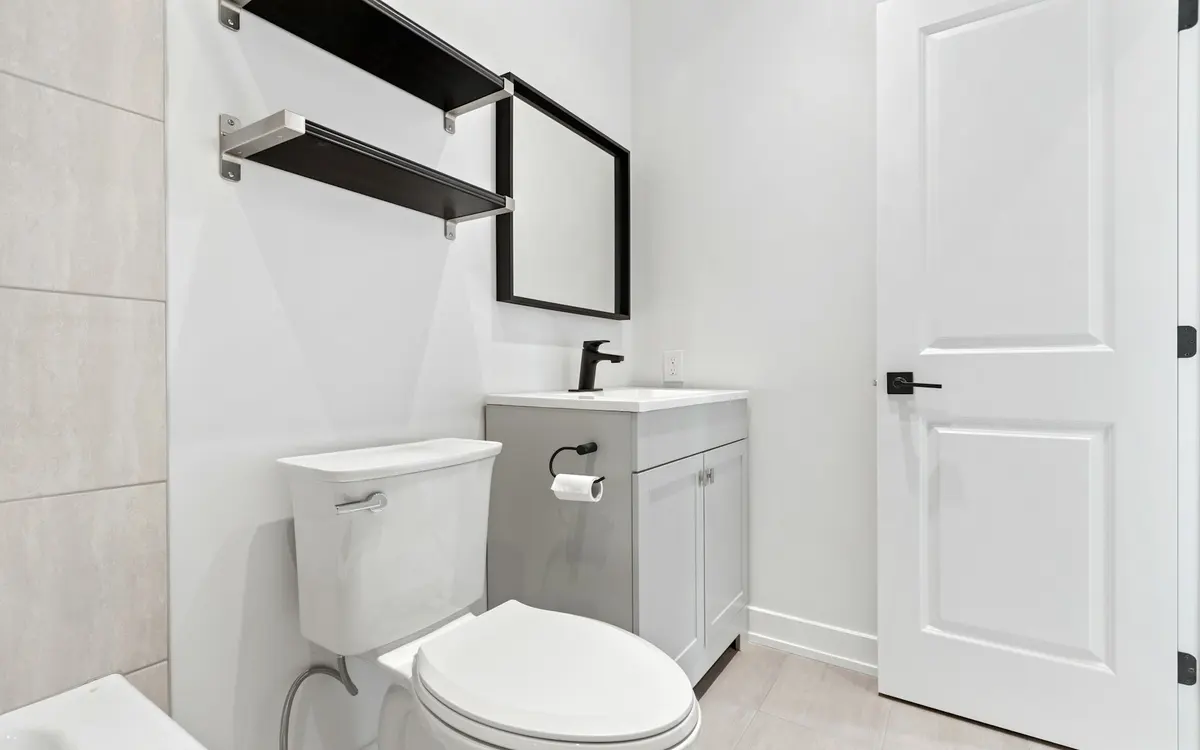
The useful bathroom storage question is not how many ideas exist but which type suits your room. Six types cover almost every bathroom — under-basin, wall-mounted, tall, slim, over-toilet and open shelving — and three things decide between them: how much floor you can give up, what your walls are and whether you may drill, and whether the problem is daily toiletries or bulk reserves. Sort the contents first, then pick the type, then the size.
Sort the contents before you choose a cabinet
Bathrooms fail because one cupboard is asked to hold four unrelated things. Split the contents into four groups and the type almost chooses itself.
- Daily routine items, reached with wet hands and one-handed: open or single-movement access at arm’s height.
- Weekly items — hairdryer, spare razors, cleaning kit, first aid: these can sit behind a door.
- Bulk reserves — toilet rolls, refills, spare towels: the volume problem, needing the tallest storage you have.
- Things that do not belong in a bathroom: most medicines, and anything electrical you would plug in near water.
Once you know the volume of the reserves you know whether you need a tall cabinet or just a wall unit. Most people buy the wall unit and keep tripping over the reserves.
The six types of bathroom storage compared
| Type | Choose it when | Floor taken | Fixing | Watch out |
|---|---|---|---|---|
| Under-basin cabinet or vanity | Plumbing needs hiding, daily items belong at the basin | None extra | Freestanding or wall-hung | Pipes eat the middle |
| Wall-mounted cabinet, mirrored or plain | Floor space is the constraint, the wall takes the load | None | Fixed to the wall | Wall type decides the fixing |
| Tall cabinet | Bulk reserves are the problem, a corner is free | Small, high volume | Freestanding, secured | Above eye level: light bulk only |
| Slim or narrow unit | A gap of 150–300 mm beside the WC, basin or door | Very small | Either | Depth beyond a bottle is wasted |
| Over-toilet unit | The wall above the cistern is dead space | None, if it bridges the WC | Legs or wall-fixed | Must clear the cistern lid |
| Open shelving or ladder unit | Items are daily and look acceptable on display | Small | Wall or leaning | Dust, steam and clutter on show |
The pattern is simple: wall-mounted and over-toilet units buy you floor, tall and slim units buy you volume in a small footprint, and freestanding pieces buy you the right to take them with you.
Wall-mounted or freestanding: the real trade-off
Wall-mounted storage keeps the floor clear, which matters more than it sounds: you can mop under it, water does not sit against a plinth, and the room reads larger. The cost is drilling, a wall that will hold the load, and holes you may have to make good at the end of a tenancy.
Freestanding storage costs nothing in permission and moves house with you, which makes it the default for renters, at the price of floor space and a wet, dusty gap at the base — prefer legs you can clean under. A tall unit, an over-toilet unit on legs and a slim trolley usually solve the whole room without a single hole, though a tall unit still needs securing.
Fixing to a bathroom wall safely
Three things decide whether a cabinet stays on the wall: what the wall is, what runs inside it, and what the fixing is rated for. UK internal walls are commonly plasterboard on timber studs, or plasterboard dot-and-dabbed onto masonry. Find the studs with a detector and fix into them wherever possible; between studs use heavy-duty anchors rated for the load, remembering ratings drop for weight pulling outward as a loaded cabinet does; on dot-and-dab, the screw and plug must reach the masonry behind. Shelving ideas covers fixings in detail.
Never drill blind in a bathroom, because cables and pipes run to the shower, the light, the extractor and the basin. Electrical Safety First is explicit: sockets are not allowed in bathrooms or shower rooms apart from shaver-supply units, unless they can be fitted at least 2.5 metres from the edge of a bath or shower tray; shaver points within that distance must be SELV or conform to BS EN IEC 61558-2-5; all circuits in or passing through a bathroom must be RCD-protected; and extension leads should not be used to power appliances there. So do not plan a cupboard around plugging something in — hairdryers and stylers are stored here at best, and used elsewhere.
Tall units need one more step: RoSPA advises that furniture at risk of being pulled over should be secured to the wall, which applies to a full-height bathroom cabinet exactly as it does to a wardrobe.
Tall bathroom cabinets and where the volume goes
A tall cabinet gives the highest volume per square metre of floor in the room, which is why it answers a reserves problem. Typical units are around 300 to 350 mm deep — enough for bottles, folded hand towels and stacked toilet rolls, but not bath sheets laid flat.
Use the height deliberately: heavy refills and cleaning kit below hip level, weekly items between hip and eye level, and above eye level only what you can lift down one-handed. Before buying, check three clearances with a tape — the room door’s swing, the radiator or towel rail, and the cabinet’s own doors.
Slim and narrow bathroom storage
Narrow units work in bathrooms because almost everything stored in one is small. A depth of 150 to 300 mm holds a shampoo bottle, a stack of flannels or a row of toilet rolls, and anything deeper hides a back row.
The gaps worth measuring are the strip beside the cistern, the space behind the open door, the run between basin and wall, and the wall at the tap end of the bath. Measure with someone standing where they actually stand — a slim unit that clips a shoulder every morning gets moved within a month.
Over-toilet storage that actually works
The wall above the cistern is genuinely dead space, and the easiest place to get wrong. Whether the unit bridges the toilet on legs or fixes to the wall, check you can still lift the cistern lid fully, reach the flush plate and get at the isolating valve — a plumber needs all three.
Two constraints then decide the design. Anything on an open shelf directly above a toilet eventually falls into it, so use closed doors or lidded boxes at that height; and nothing on that wall may block a window or the extractor fan.
Towel storage: the category that decides the rest
Towels take more volume than everything else in the room combined, so where they live decides how much cabinet you actually need. Work out the real number first. Most households need one towel in use and one clean per person, plus a small guest set — not the pile that accumulates because old towels are never retired.
Then split them by state, because a wet towel and a clean one want opposite things.
| Towel | Where it belongs | Why |
|---|---|---|
| In use, still damp | A hook or rail with air on both sides, never folded away | A folded damp towel stays damp and starts to smell |
| Clean, in rotation | An open shelf or ventilated basket in the room | Reached for wet-handed, so no lid and no door |
| Reserve and guest sets | A landing or airing cupboard outside the bathroom | Bathroom humidity is the wrong home for stored textiles |
Hooks beat rails for anything that has to dry, because a towel on a hook keeps more of its surface open to the air than one folded in half over a rail. Rails look tidier and suit a towel that is already dry. If the room has a heated towel rail, treat it as the drying point rather than the storage point: it handles two or three towels well and becomes a bottleneck at four.
Rolled towels on an open shelf are the usual photograph and they do work, provided the shelf is not directly above the bath where steam settles hardest, and provided the rolls are loose enough to let air through. Keep the reserves out of the room entirely — the same ventilation logic that governs the rest of this page applies hardest to a stack of cotton.
Under the basin
The cupboard under the basin has its own problems — the trap, supply pipes, leaks and child access — and its own guide. Layout, leak trays, pull-out caddies and chemical safety are all in under sink storage.
Damp, ventilation and what a bathroom does to stored things
UK government guidance on damp and mould is clear that where a dwelling is inadequately ventilated, moisture in the air cannot escape, and it names bathrooms and kitchens as the rooms that particularly need effective ventilation — working extractor fans, openable windows and trickle vents. It is equally clear that behavioural adjustments are never a substitute for addressing the underlying cause, so persistent mould points at the building, not at how a cupboard is packed.
For storage that means three rules: never let a cabinet, shelf or box block the extractor fan, a trickle vent or the window; do not seal a full cupboard flat against a cold external wall with no air gap; and keep out what humidity ruins — cardboard, loose paper, open cotton wool, leather and towels that never get aired. Reserves do better in a landing cupboard, and storage boxes covers which containers suit damp spaces.
Medicines, blades and small hazards
A bathroom cabinet is the traditional place for medicines and one of the worse places for them. NHS guidance is to store medicines in a cool, dry place away from direct sunlight, heat and moisture, and specifically to avoid storage near heat or humidity such as kitchens, bathrooms, sinks or radiators. It also advises keeping them in their original packaging, in a childproof place out of reach of children and pets, and checking expiry dates, since expired medicines can be dangerous. Unwanted medicines go back to a pharmacy, sealed in a clear plastic bag.
RoSPA gives the same direction: keep medicines and chemicals out of sight and reach of children, preferably locked, store chemicals in their original containers, and dispose of unwanted ones safely. A lockable box in a bedroom or hall cupboard is the better medicine store, and it frees the bathroom cabinet for what it is good at. Razors and nail scissors follow the same principle.
White, wood or mirrored: choosing the finish
White units dominate because they match sanitaryware and cost little, but construction matters more than colour. Most inexpensive bathroom furniture is MDF or chipboard with a foil or painted finish, and the weak point is an unsealed or chipped edge, where water gets in and the board swells irreversibly. Check that edges and cut-outs are sealed, keep units off a regularly wet floor, and wipe the base rather than letting water stand against it. Mirrored fronts do two jobs in one footprint at the cost of showing every splash.
What commonly goes wrong
- Buying storage before separating daily items from bulk reserves, so the wrong type arrives.
- Choosing a deep unit for a narrow gap, then losing everything at the back.
- Drilling without checking for cables and pipes, or without matching the fixing to the wall.
- Leaving a tall unit unsecured where children can climb.
- Blocking the extractor fan, a trickle vent or the window with a shelf.
- Keeping every spare beside the one in use instead of one limited reserve area.
Quick checklist
- Contents split into daily, weekly, bulk reserves and “does not belong here”
- Type chosen for the real constraint: floor, volume, or permission to drill
- Gaps measured with doors open and someone standing where they stand
- Wall type identified, cables and pipes checked, fixings matched to the load
- Tall units secured; fan, vents and window left clear
- Medicines and chemicals out of the humid room, in original packaging, out of reach
- Reserves in one limited, visible area
With the type settled, the remaining friction is inside the units: drawer organisers covers vanity drawers, and storage ideas for small spaces applies the same decision room by room.
Sources and references
Frequently asked questions
Questions before you begin
Where should I store towels in a bathroom?
Split them by state. Towels in use need a hook or rail with air on both sides so they dry rather than sit folded and damp; clean towels in rotation suit an open shelf or ventilated basket you can reach wet-handed; reserves and guest sets do better in a landing or airing cupboard, because bathroom humidity is the wrong environment for stored textiles.
How many towels does a household need?
For most homes, one in use and one clean per person, plus a small guest set. The pile that fills a bathroom cupboard is usually old towels that were never retired rather than towels anyone uses, and towels take more volume than everything else in the room combined.
What type of bathroom storage is best for a small bathroom?
The type that buys back the constraint you actually have. Where floor space is short, wall-mounted and over-toilet units keep the floor clear; where the problem is bulk reserves, a tall cabinet gives the most volume per square metre; where there is only a gap beside the WC or behind the door, a slim unit of 150 to 300 mm deep is the only thing that fits.
Wall-mounted or freestanding bathroom cabinet — which is better?
Wall-mounted keeps the floor clear so you can clean under it and the room reads larger, but it needs drilling, a wall that will take the load, and holes you may have to make good at the end of a tenancy. Freestanding needs no permission and moves house with you, at the cost of floor space and a damp gap at the base. Renters should usually go freestanding, with legs rather than a solid plinth.
How deep should a slim bathroom cabinet be?
Between about 150 and 300 mm for most contents. That depth holds a shampoo bottle, a stack of flannels or a row of toilet rolls facing you, and anything deeper simply hides a back row you will forget. Measure the gap with the room door open and with someone standing where they normally stand.
Is over-toilet storage a good idea?
It uses genuinely dead wall space, provided three things still work: you can lift the cistern lid fully, you can reach the flush plate or button, and the isolating valve stays accessible. Use closed doors or lidded boxes rather than open baskets directly above the pan, and never let the unit block the window or the extractor fan.
Can I fix a bathroom cabinet to a plasterboard wall?
Yes, but the fixing decides whether it holds. Find the timber studs with a detector and fix into them wherever possible; between studs use heavy-duty plasterboard anchors rated for the load, remembering ratings drop for weight that pulls outward. Dot-and-dab walls need a longer screw and plug reaching the masonry behind, and you should never drill blind in a bathroom, where cables and pipes run to the shower, light and extractor.
Should I keep medicines in the bathroom cabinet?
Usually not. NHS guidance is to store medicines in a cool, dry place away from direct sunlight, heat and moisture, and specifically to avoid storage near heat or humidity such as kitchens, bathrooms, sinks or radiators. Keep them in their original packaging, in a childproof place out of reach of children and pets, and check expiry dates. A lockable box in a bedroom or hall cupboard is a better medicine store.
How do I stop bathroom storage getting damp or mouldy?
Keep the moisture moving and the storage off cold surfaces. UK guidance on damp and mould is clear that where a home is inadequately ventilated, moisture in the air cannot escape, and that bathrooms particularly need effective ventilation — so never let a cabinet or shelf block the extractor fan, a trickle vent or the window. If mould keeps returning, the cause is in the building, not in how the cupboard is packed.
Can I have a socket in a bathroom for a hairdryer or electric toothbrush?
Electrical Safety First states that sockets are not allowed in bathrooms or shower rooms apart from shaver-supply units, unless they can be fitted at least 2.5 metres from the edge of a bath or shower tray, and that shaver points within that distance must be SELV or conform to BS EN IEC 61558-2-5. All circuits in or passing through a bathroom must be RCD-protected, and extension leads should not be used to power appliances there. Plan the storage so appliances are used in another room.


